
Understanding the ruling, the shift in legal accountability, and how it might not be the win some people think it is.
I’m gonna say something that will probably tick off my Democrat friends, but kind of also throw off my Republican friends, because I’m not saying what they think I’m saying.
I’m glad SCOTUS ruled the way they did, re: nationwide injunctions by lower courts.
Yes, I’m still politically unaffiliated and no, I’m not taking sides. This has to do with politics, but more than that, it’s about our legal framework as a country.
Before I get into what I want to say, there’s a bit of history to cover first.
For most of US history, lower courts issuing nationwide injunctions wasn’t a thing. It really wasn’t.
The first use was back in the 1960s. Then, in the 40 years after that – from the 60s to early 2000s – it was only used a few times.
It really took off during the Obama era, where it was used A LOT. And looking at both Trump eras, it’s still being used quite a bit.
Unlike what a lot of talking heads and pundits like to say, or even the administration, it’s not a “rogue judge” making a call. It’s usually a ruling that happens when a case going before a single judge.
That said, nationwide injunctions were meant to be rare – a legal safeguard. But in our growing and hostile political landscape, they became a tactical weapon, and yes, they were abused.
But it was only a legal Band-Aid, and not real legal work.
I say that believing that they were abused because it was a quick and easy fix so that we didn’t have to do what we’ve always done – battle it out on the legal merits.
As a result, there wasn’t really any real consequence when authorities broke the law or violated the Constitution.
It became a political game of tit-for-tat where nobody ever really faced consequences.
What SCOTUS’s ruling did was reset the legal field.
Now, SCOTUS has said that the executive order trying to dismantle birthright citizenship, and others, can be challenged under the Administrative Procedure Act (APA) – which is what we did before lower courts leaned so heavily on nationwide injunctions.
And here’s the part that I think people are sleeping on – there’s real accountability now.
Under the APA, while the president himself might enjoy protections, the departments in the executive branch that carry out illegal orders – DHS, DOJ, HHS, etc. – can be held liable, and not just civilly. Criminally.
See, nationwide injunctions were also a shield.
The widespread use of nationwide injunctions didn’t just block executive actions; in a weird way, they also shielded the executive branch from deeper legal consequences.
By blocking policies outright, there was never a trial. No evidence weighed. No rulings on constitutional grounds. No civil or criminal liability assessed.
So yeah, while it might seem like a loss to my Democrat friends? It’s really not.
This was a correction.
In my opinion, I see it as a correction of an imbalance in the legal system.
Now is the time – the opportunity – for states to start working together again, to start building real legal foundations that can’t be knocked over by a handful of executive orders.
We haven’t had that in a while.
And here’s the part that really got my mind turning.
Almost everyone I know is calling this a win for Trump – but is it really? Follow me here.
With nationwide injunctions as they were, the DOJ was essentially defending one big lawsuit. Now? Now, they have defend hundreds, maybe thousands, of smaller lawsuits from every corner of the country.
That’s not a win. That’s a legal siege.
So, why did I call it a Trojan Horse ruling?
Because once I realized that the DOJ was about to bombarded with so many cases, I had to ask the question, “Did SCOTUS know this would happen?“
Because if SCOTUS knew this would happen – and trust me, I’m pretty sure they did – then this wasn’t just a ruling.
It was a Trojan Horse. It looked like a gift to executive power. Like the Court was saying, “Here – you don’t have to deal with nationwide injunctions anymore.”
But what they really did was crack the door wide open for localized lawsuits, fragmented rulings, and death by a thousand court filings.
It’s judicial judo. Redirect the force. Let them exhaust themselves trying to fight it all at once.
If that was intentional – and I think it might have been – then this might be the most silent but loud judicial protest we’ve seen in modern history.
And it’s already started with the recent rulings in California.
TikToker Rachel Hall, in viral video asked an interesting question while she was cooking. Who cooks better, black people or white people? In her video, she briefly speaks about how some people focus on stereotypes, like no seasoning, then she genuinely asked for the opinions.
There were several comments, reposts, and stitches, (many worth checking out if you go down that rabbit hole), ranging from very serious to very funny. Some were enlightened, yet others… not so much.
I couldn’t help but respond in a way that aims to shed light on such stereotypes, as well as educated. As always, my goal is to bring insight and help people better understand each other so there’s a little less hate in the world.
Sure they cook well. Some of the best cooks in the world are white. For example Gordon Ramsey. Let me break this down for you guys.
“White” is not real in the sense of a people or race. It’s a category for people of a fair skinned complexion, but encompasses various cultures.
In the US black people call themselves “black” or “African American” because that is the culture and heritage the created after having theirs stripped from them.
I bet everyone reading, at some point, they said, “I love Italian food”, right?
Or when you’re looking for places to take a date, “there’s a new French restaurant across town we should try”.
If you walk down the street of New York today, I bet you a dollar that there’s a Greek restaurant not too far from a Russian restaurant.
See, “white people” – of European descent – while historically many weren’t considered “white” in the US, they are a part of the “whiteness” categorization today.
Italian food, Russian food, Irish food, Canadian food, French food, Greek food, German food, and more.
Today, they are categorically white. Heck, even some Latinos are white.
This is why racism is stupid, because it’s made up.
When I hear a person with racist leaning ask, “what month is white history month?” it let’s me know they don’t understand that every month is white history month.
Every month recognizes a people’s heritage month. We recognize black history month because they don’t have a heritage anymore after it was stolen from them.
Ask a black American who’s a descendant of slavery where their heritage is, and they can’t tell you which of the 54 countries in Africa they come from.
They couldn’t tell you if they’re from Angola, or Mozambique, or Morocco, or Egypt, or Nigeria.
There’s no Gambian-American heritage month. No Senegalese-American heritage month.
But there is a Greek-American heritage month, Italian-American heritage month…
Along with Irish-American, Asian-American, Jewish-American, Arab-American, French-American, German-American, Irish-American, Polish-American, Filipino-American, and many more.
And some of them have damn good food!
We need to stop the whole white vs black nonsense.
The only legitimate people that can call themselves “black” in terms of heritage are those who descended from slavery.
Everyone else has their heritage, including those from the Caribbean and those from the Motherland.
Yes, we’re black people, but unless we descended from a type of slavery that robbed us of our heritage, “black” isn’t our identity. It’s just our complexion.
And “whiteness” isn’t real. They still have their heritage, and we rightfully celebrate them.
It’s our diversity that makes us great.
Out motto is “E Pluribus Unum” – out of many, one.
It has been quite some time since I’ve written, and I wanted to begin sharing about my journey of personal growth and personal development.
Today I had an epiphany. As an entrepreneur engineer, I’ve learned something about myself today in regard to my own mindset.,
When it comes to accomplishing tasks and setting goals, I still think like an engineer and not an entrepreneur. Rather, I only think like an engineer and fail to consider the point of view as a business person as well.
As an engineer, my focus is largely how to fix problems. I’m very good as seeing something that’s broken and finding a way to fix it. I, given time, can find a way to fix just about anything that’s broken.
And, if there’s something I need to learn in order to accomplish that, I will lose myself in study, learning whatever that is, then go back and fix the problem.
When people ask, “can you make it work?” the answer is almost always yes. That’s the up side to being an engineer.
The down side is that I’m almost always convinced that I can take a problematic project and make it work within a given timeline.
It is my own confidence and drive overwhelming practical judgement. It is, as I’ve heard it explained, the unrestrained ambitions of being a brilliant engineer.
On some level I already knew this about myself, because I often tell clients that if they want something done then give me a deadline or a goal to hit, but I didn’t understand it until this morning.
It’s quite possible that this little feature, (it’s not a flaw), in the way I think may very well be the reason why I’m good at landing clients, (because it’s a goal), but why I’m not consistent the way I’d like to be, (because consistency is not a goal but a behavior and character trait).
Engineers are notorious for having a wake of ‘started but unfinished’ projects in their wake.
I’m no different.
And now that I understand this about myself, and I am aware of it, I can adjust.
I realize this post may be divisive, especially in our current political climate, but I feel the need to explain this.
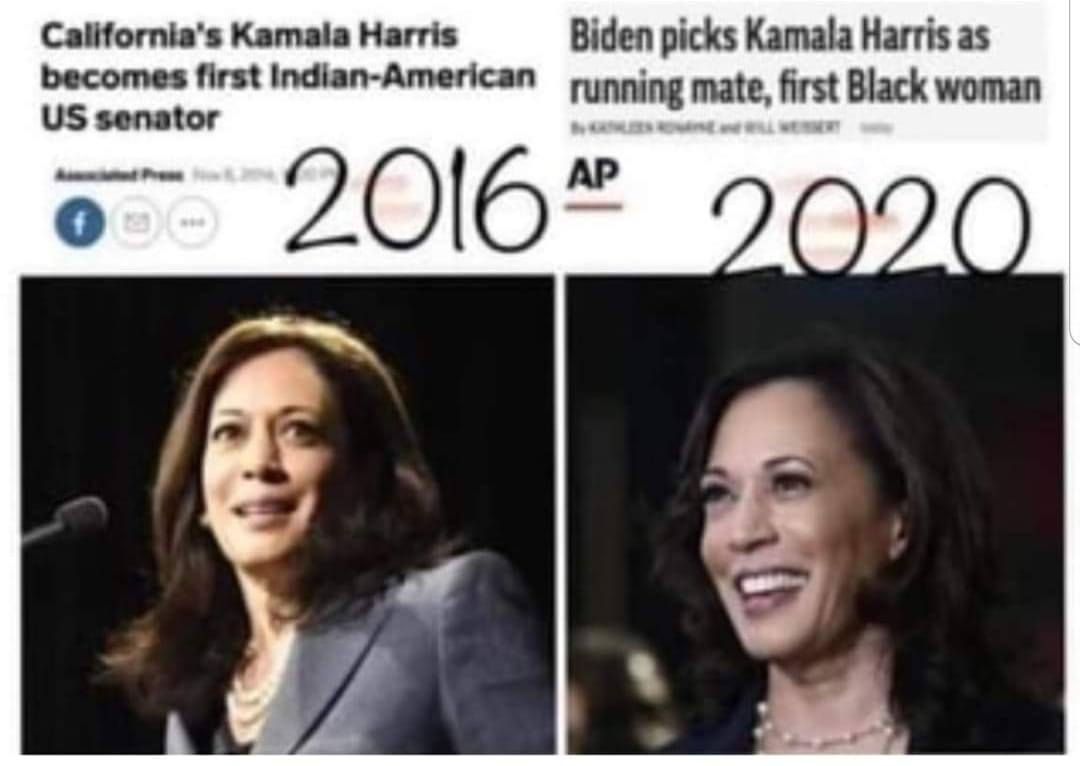
Earlier today, I saw a post that was a deliberate slight against Kamala Harris, and I have to admit I was taken aback by it.
This is the image.
The person who shared that image added the caption, “Bol girl stop playing which is it?“.
My gut wrenched a little bit, because it wasn’t just a black person that shared it and asked that question.
It was a black pastor.
And if you look at his timeline, he was talking about how black people should stop voting for color and look at their policies, and then he goes on in great detail about her color, circulating a lie that her father is Indian too and the just immigrated to Jamaica, and she isn’t really black.
As a black person with a mixed background, it was hurtful because I remember being told by bullies that, “I’m not really black” because I wasn’t like them.
I didn’t walk, talk, dress or act like them, and I wasn’t like any other black person they knew, so I must not be black.
Well, I quickly set them straight, and I’m going to set the record straight about Kamala Harris too, (not that she needs me to, but because apparently some people in my sphere of influence needs to hear it from a peer in their own circles).
For the record, (addressing the claim that her father was Indian too and they just immigrated to Jamaica), Kamala Harris’ mother was born in Painganadu, India, (almost a couple hundred miles south of Chennai), and her father was born in Saint Ann’s Bay, Jamaica.
The claim is a blatant and mean-spirited lie — whatever the reason or purpose for it, I don’t know, but it is a lie.
I’d also point out that it’s also the same kind of ill-spirited and hateful political nonsense that fed Obama’s birther conspiracy.
It’s interesting to see how the same black people who were upset about the birther conspiracy, do the exact same thing to a black woman. It’s hypocritical at the very least.
Regarding how she identifies, you all know that she can be BOTH right?
First of all, “Black” isn’t a nationality or country of origin, and second, Kamala Harris’ parents, as was made clear, were Indian and Jamaican. And she is an American.
What that means is:
She can identify as black.
She can identify as Indian.
She can identify as Asian (because India is on the Asian continent).
She can identify as Asian-American.
She can identify as Indian-American.
She can identify as Jamaican-American.
And this one will flip you…
Jamaica has African roots, so she can even identify as African-American and claim her African roots just as much as any other black American person can.
NONE of that means she isn’t a black woman.
She is a black woman with a diverse heritage, and she doesn’t have to choose which part of her heritage she has to identify by, and it’s wrong and small-minded for anyone to expect or demand that she does – especially of black people.
She can be all of it and honor all of her heritage.
Stop trying to make people of mixed heritage choose part of their identity and ignore the rest.
The more I think about the president’s plan to make payroll taxes permanent and pay for Social Security, Medicare and other disability and insurance programs with the general fund, the more I think the president might be a secret Democrat.
Follow me here.
If we’re SO against having taxpayers pay for everyone’s healthcare because Universal Healthcare is socialism, then we should also be against having taxpayers pay for everyone’s Social Security, Medicare, disability and insurance programs too, shouldn’t we – because that is also socialism.
The general fund IS taxpayer money – so the president’s plan to pay for Social Security, Medicare, etc. with the general fund? It’s a debt to the public.
That is EXACTLY what democrats have been trying to do with healthcare, except it’s WAY more.
Democrats only wanted general healthcare. The president’s plan will add to the taxpayer burden Social Security, Medicare, disability, and other retirement and insurance programs that the payroll tax covers.
The president is giving democrats a HUGE win as I see it.
I don’t think the president thought this one all the way through. Up front it sounds like a nice plan – we’ll defer payroll taxes until the end of the year, put money back into the employee’s pockets, etc. etc.
It’s a nice pitch, but if you really think a few moves ahead, more money in your pocket means you pay more in taxes, and you’ll still have the burden of paying for Social Security, Medicare, and the other programs because they’ll be paid for out of the general fund.
Of course, instead of paying it just for yourself when you retire, you’re paying it for everyone else too.
How is that not socialism?
What I think will happen is that this that they’ll use this as an opportunity to phase out all of those programs.
One of the most effective strategies the republican party uses to cut a program they can’t just cut without facing outrage from the public is to defund it.
The programs are still there. They just aren’t being funded. Same difference.
For decades the republican party has been to brand programs like Social Security and Medicare as entitlements so they can cut them under the banner of “cutting entitlements to reduce deficit spending” and prop up themselves as the party of fiscal responsibility.
The problem is that nobody was buying it. These programs are paid for with payroll taxes, which means that they don’t add to the deficit or to the national debt, and people were paying for them directly, with matching funds.
That’s not an entitlement. It’s a savings and investment.
This makes it pretty dicey territory when the programs get cut, and/or when Congress spends from it, because neither are supposed to happen; and if they do spend from it, they should pay it back.
What the president’s plan will do is make Social Security, Medicare and other programs that payrolls taxes currently pay for entitlements, by shifting the burden of costs to the taxpayers.
Those programs will then be counted as deficit spending and add to the national debt. What they’re doing is making those programs “entitlements”, and “the party of fiscal responsibility” will, I think, use that to defund those programs.
Of course, are they doing to refund the money that hard-working Americans have paid into those programs their entire working lives? I highly doubt that.
On of my friends, a Trump supporter, says the president has this and will figure it out, but right now I can’t help but think that this was the plan all along.
The deficit is out of control, and the crackdown on immigration has cost the government untold millions of dollars, because one of the things about the programs payroll taxes cover is that immigrants pay into these programs and they’ll never be able to collect because you have to be a citizen.
There is a surplus of money, or should have been, but Congress couldn’t keep putting their hands into the piggy bank.
That’s YOUR money they’re spending…
Listen to the Mnuchin explain on the Fox News Sunday interview.
https://youtu.be/Fhqrl7ihcWg
As I said… I can help but think this was the plan all along.
It would take a very heated issue for me to actually post a political post, but I wanted to offer a point of view here that most people have not considered, regarding the main argument about losing legacy or erasing history because confederate flags and statues are removed, or companies like Quaker Oats changes a brand like Aunt Jemima.
And I didn’t want to just offer a point of view, because complaining about something never actually solves anything. I wanted to offer a solution, because the right action solves problems, and I wanted to give people something to act on.
I’m going to break this down into two parts:
My point of view.
The solutions.
A. The Point of View.
1. I’ll start with an easy, if not controversial one. In the case of Aunt Jemima, Nancy Green and the other women, (at least 9 others), were employees. They don’t own the Aunt Jemima brand.
Why is that significant?
The definition of a legacy is “a gift of property, especially personal property, as money, by will; a bequest,” (Merriam-Webster).
If you don’t own it, it cannot be a legacy. Aunt Jemima is a legacy for Quaker Oats, not a legacy for the families of the women who played the role of Aunt Jemima.
At the end of the day, no matter how famous they became, or how they leveraged the job, how many people they inspired, or how proud the family is of everything the women who played Aunt Jemima was, it was still just a job.
They were still employees. It is history for those families, but not a legacy, because they don’t own Aunt Jemima.
2. This one is a matter of principle that everyone should be able to understand. If you run a company and hire employees, if they became famous through the job, should you be beholden to a former employee because they don’t want you to change your brand?
Obviously not. In the corporate world, that’s just crazy. Can you imagine the scenarios?
Imagine a model who was the face for a line of product, trying to hold the company that makes that product accountable because they want to change their brand.
The bigger the company, the bigger the nightmare too.
Imagine if Nike for example, wanted to alter the swish logo, only to have every athlete that were featured on the brand try to tell them they can’t change the logo because it would ruin their legacy, or erase history.
No company in their right mind would ever give employees that kind of control over how their business operates like that, and no former employee, regardless of how famous they became, should have that kind of control.
Let’s take it one step further.
Imagine your last job as an employee for a moment. Now imagine that they’re changing the brand. Do you have a right to tell them they can’t because you were made famous as an employee representing that brand?
When you think about it, it’s kind of silly to even consider, isn’t it?
3. This is the one that gets people fired up. You ready?
Removing or changing brands, symbols, flags, monuments, statues, etc. does NOT erase history.
Much of society today, and this is my opinion, lacks object permanence. What is that?
In psychology, object permanence is the understanding that objects continue to exist even when they cannot be seen, heard, touched, smelled or sensed in any way.
History is such an object.
And because people lack object permanence, you get arguments like, “we only have new cases of COVID because of testing” which is absolutely ridiculous. Point of fact, testing doesn’t give us new cases.
Testing is the equivalent of a measuring stick or a ruler.
We have new cases because there are infected people and it’s spreading. If people weren’t getting infected, the testing would show that infections are decreasing, because less and less people would be getting infected or sick.
That is a lack of object permanence, meaning that some people don’t understand that people are getting infected whether there was testing or not.
What testing is doing is giving us an accurate measure of how many people are sick, because the numbers before were estimates and partial figures from people who actually were tested.
That the numbers are going up is evidence of what experts have been saying, that there are more people infected than we know. All testing is doing is showing us how many more.
The lack of object permanence is why you get the argument that removing monuments erases history.
History is history because it is history. It’s in the past, and changing the present or the future does not alter the past.
What changes is whether or not the history is recorded.
In a sense, the lack of object permanence is “out of sight, out of mind” one step further, to where it becomes “out of sight, out of existence,” because some people really need to see to believe, and if they don’t see a constant reminder, it’s as if it doesn’t exist.
And now that you understand the perspective, here is the solution.
B. The Solution.
This is actually a 2-part solution. I spent almost a week debating this topic every day before I could fully appreciate and explain the perspective you just read, and the solution is surprisingly simple.
So we have the problem. How do we solve it?
(And this is where I would expect people to take action).
1. Regarding history and legacy, now that we know the brands, the statues, the flags, and so on are not legacies, and the problem with their removal centers on the recording of history…
The families who feel their history or legacy is being erased or destroyed, should create their own family history book or history archive.
This will first, record their history so that no change or removal of brands or monuments will erase that history.
Second, that history will become a legacy because they own that, and they can pass that book or archive down through their family.
I would also point out that this is how humans have passed on history since the beginning of human history. It was done through word of mouth and songs, (like the slaves did when they were forbidden to read), family albums, writings, etc.
There is nothing that is stopping anyone from continuing to do what humans have done for thousands of years.
2. As pointed out, it’s wrong to try and force companies like Quaker Oats from changing their brands; futile really. That said, there is an opportunity here to kill two birds with one stone. Create a company brand museum.
First, for the families that are complaining, if they truly feel they need some kind of outside proof, verification, even publicity or confirmation of their history, a brand museum would be a great way to give them that.
And second, the company can continue to make money off of the brands they no longer use or have changed. A brand museum would be a great legacy for the company, and a unique tourist attraction for the company that can be leveraged to attract new customers and business.
It would preserve the purpose of a brand, and in a sense repurpose old content that can be promoted again.
It’s an interesting question isn’t it. Would you rather be an instant millionaire, or take $10k per month for life?
It was asked in a group I belong to and a lot of people chose the $10,000 per month option. Very few said “instant millionaire” like I did, and many were curious as to why I would.
So here is my initial response.
First, no one knows when they’re going to die. Planning for the future is great and all, but 10k a month would take you 8 years to make a million.
That’s a lot of missed opportunity.
Instant millionaire gives you cash flow options, and a bit of freedom to take action on some things. Also, if you become an instant millionaire you don’t go right into investing.
You would invest with 10k a month to build a million dollars. You become an instant millionaire, you look for cash flow and capital gains to safely retain and grow your wealth.
A lot of people who win the lotto and get inheritances go broke trying to invest.
Then I recounted a real life story of a friend who got a $3m inheritance and he’s grown it to over $35 million in the past 10 years. The only thing he invested in was himself. Education, knowledge…
A lot of people wanted to learn more, but there is a character limit on replies, so I’m writing this blog post. Enjoy.
Have you read the book Money: Master The Game by Tony Robbins? Or listened to wealth builders like Warren Buffett, Grant Cardone, Tai Lopez and others?
The first time I heard about that piece of advice is from Mark Cuban. He was doing an interview – and I don’t remember with whom, but that’s the BIG nugget I got out of the whole thing.
They were talking about immediate wealth, specifically people who win the lotto or come into a big inheritance and how a few years later a surprisingly large amount of them are broke.
The reason is that they have not been prepared or educated to have wealth, because they’ve been raised up in a system designed to teach the masses how to work.
The most common advice to build wealth is to invest, but when has the masses ever been taught to invest?
What happens is, they get a lot of wealth and they suddenly become investors without any knowledge or experience of how money works on that level so many of them lose it. They aren’t investing, they’re gambling.
On top of that they’re buying all of this stuff that are essentially liabilities if they’re not handled properly. Houses, cars, etc.
Instead of staying frugal, they become big spenders, without any accountability.
So they’re spending out of control, they’re gambling, and they’re taking on more liabilities, (things that require money to maintain), and the inevitable is that sooner or later, they end up broke and even in debt when the money runs out.
So what should you do with lump money when you become wealthy instantly?
This is would be MY plan if I became an instant millionaire, based on everything I’ve learned so far, and I will say that disclosure this is NOT intended to be financial advice.
I’m just sharing what my plan would be and what my thoughts are.
Why I Chose Instant Millionaire And What I Would Do With It
Instant Millionaire or $10,000 Per Month? What I would do…
1. Remain Frugal.
I would continue to live as you’ve been living. By all means, pay off your debts, maybe move into a bigger house if you need it, but be reasonable.
Paying off your debts would be something like school loans, arrears, maybe pay off the car, even the house if it’s not an exorbitant amount.
For example, let’s say you’ve got a $300k house and you still owe $200k or more, just hold off on that one for a bit because you really don’t want to use up too much of your money all in one shot.
Or pay off and close all but the oldest line of credit with any cards so as not to ruin your credit score.
You remain frugal to a. keep your monthly liabilities low and b. maintain/build your credit score.
Most people will increase their living expenses, you want to stay the same or decrease it.
2. DON’T quit your job
After paying off your debts, something interesting happens. Your job becomes an asset.
Most people live paycheck to paycheck because their job is a liability. Their living expenses is either just enough to maintain their lifestyle, or not enough to and they need “creative financing” to stay where they’re at. Miss one or two paychecks and they lose everything.
However, large influxes of money give you an opportunity to reduce your monthly liabilities.
For example, an opportunity with large cash influxes is doing a refinance with a principal payment and dramatically bringing down the monthly payment.
So let’s say the monthly mortgage is $1500 per month, you do a refinance to preferably a fixed rate, NOT taking any money out, but instead put down say $50,000 or $60,000 on the principal, and suddenly you don’t have $1500 per month to pay anymore, you have like $800 or $900 per month.
You just freed up $700 or $800 per month.
So, if you make $5,000 per month and you were having trouble keeping up, take away the student loan payment, excess credit card payment, the car payment, etc. and include a reduced mortgage payment, suddenly $5,000 isn’t a liability anymore, it’s an asset – a stream of income.
3. Set aside 2 years of living expenses.
For most people, they maintain a home with $5,000 per month. For some it’s more, for some it’s less, but set aside 24 month of expenses. Not bills, but expenses.
Eating out, hanging out, Netflix, Hulu, etc. Include the misc. stuff you spend money on each month, and put yourself on that budget.
So set aside $120,000, ($5,000 x 24) in an interest bearing account and leave it alone.
I would look for the highest available interest rate return, and an account that eliminates fees by maintaining a certain balance, and just let it appreciate over time, and let the interest compound.
4. Business-like banking structure.
This is something I actually adopted quite a while ago. I used to have a problem with overdrafts and stuff when I was younger, before I learned about money management and how to protect my money from predatory practices.
All of my money is held in a high-yielding interest account, that I call my holding account.
My goal with doing that is to make sure my money doesn’t lose value over time. There are no fees on the account and the interest compounds over time.
The more money in it, the more options become available, including higher returns which allows my money to continue to make money over time.
I have a separate account where I get paid. So my clients, gigs, etc. when I get paid, all deposit to that account. That’s my accounts receivable.
From there, the money that I make gets divided up into other areas.
The first, is another bank account with no overdraft protection or overdraft fees. The reason for that is because nobody should have access to or drafting back where I keep large sums of money.
This is accounts payable, a.k.a. bills and debts.
I calculate my monthly expenses for the following month and transfer the money to that account. Mortgage, car payment, insurance, cc payments, etc. Anything I need to pay the following money will be there, plus the minimum balance so that the monthly fees are eliminated.
You know how a lot of companies think they own you, like it’s their money? They don’t want a card, they want a bank account and routing number? That’s what this account is for.
Never give anyone direct access to your source. It’s bad enough that the bank has access to it.
Then I have a personal savings and a personal checking. The money for my personal savings go first, and what’s left over goes into my personal checking.
I grow my savings with programs that allow me to do things like forward the cash back to my savings, or roll over the amount up to the nearest dollar to my savings, and I have a monthly commitment to add to my savings.
Savings are for emergencies. Car breaks down, refrigerator stops working, etc. I’d take a part of what’s left over and continue to contribute to holding too.
If I followed the steps, all of my money is growing slowly over time and not losing value, and because I have less monthly liability I have a bit of money freedom to do things.
After I’ve contributed to everything to make sure my money grows and doesn’t lose value, the rest of the money is for whatever I want, but more importantly, it’s for investing in myself. finding a mentor, buying books, taking classes, learning and growing.
I’d learn about finance, business – maybe even start one.
THEN I would look at becoming an investor.
I know the cashflow quadrant says the goal is to become a business owner and investor as fast as possible, but the CQ assumes progression from employee and self-employed to business owner and investor. It assumes time for learning and experience over a period of time, usually years.
If wealth is just dropped in your lap though, ASAP is dangerous. There’s no way to skip learning and having experience.
So if it happened to me, MY GOAL would be to first make sure that my new wealth continues to grow and is protected, second turn my existing income into as asset by reducing my monthly liabilities, third create an income buffer to hedge against economic disaster.
I chose 24 months, because the ’08 ’09 crash was pretty bad and left me out of work for 18 months, and it took about 4-6 months for me to get a business going to where I didn’t have to worry about immediate money problems – so 24 months.
Fourth? I would focus on growing as a person and learning finance and business.
If time was a problem, I would go from full time to part time hours with my clients and free up that time, but I wouldn’t quit my clients. This will prevent me from relying on my holdings to live on.
The 5th step would be to then start investing, and I would invest in cashflow opportunities primarily to rapidly grow my holdings.
I’d want to not lose money at all, but grow it.
I would let go of my clients ONLY when I have another income stream that would maintain my lifestyle, and I needed the time freedom to do other things.
Even then, I would probably incorporate, and hire someone to do the work for me so that I don’t lose that income stream. And after incorporating I’d restructure my banking to further protect my wealth and lower my tax footprint.
Come June 12th 2020, I will have been working from home full time for 8 years. That’s from not knowing ANYTHING about business or finance at all, so I’d probably maintain for 3-5 years before moving away from doing the fulfillment for clients personally.
I’m 41 right now – will be 42 in November. So by 47, life would be my oyster. I’d be able to do what I want, go where I want, help who I want. Pursue other passions.
$10k a month isn’t enough for me to pursue my calling in life. I need to grow wealth in order to fulfill that which I see as my purpose and help those that my calling will help.