It has been quite some time since I’ve written, and I wanted to begin sharing about my journey of personal growth and personal development.
Today I had an epiphany. As an entrepreneur engineer, I’ve learned something about myself today in regard to my own mindset.,
When it comes to accomplishing tasks and setting goals, I still think like an engineer and not an entrepreneur. Rather, I only think like an engineer and fail to consider the point of view as a business person as well.
As an engineer, my focus is largely how to fix problems. I’m very good as seeing something that’s broken and finding a way to fix it. I, given time, can find a way to fix just about anything that’s broken.
And, if there’s something I need to learn in order to accomplish that, I will lose myself in study, learning whatever that is, then go back and fix the problem.
When people ask, “can you make it work?” the answer is almost always yes. That’s the up side to being an engineer.
The down side is that I’m almost always convinced that I can take a problematic project and make it work within a given timeline.
It is my own confidence and drive overwhelming practical judgement. It is, as I’ve heard it explained, the unrestrained ambitions of being a brilliant engineer.
On some level I already knew this about myself, because I often tell clients that if they want something done then give me a deadline or a goal to hit, but I didn’t understand it until this morning.
It’s quite possible that this little feature, (it’s not a flaw), in the way I think may very well be the reason why I’m good at landing clients, (because it’s a goal), but why I’m not consistent the way I’d like to be, (because consistency is not a goal but a behavior and character trait).
Engineers are notorious for having a wake of ‘started but unfinished’ projects in their wake.
I’m no different.
And now that I understand this about myself, and I am aware of it, I can adjust.
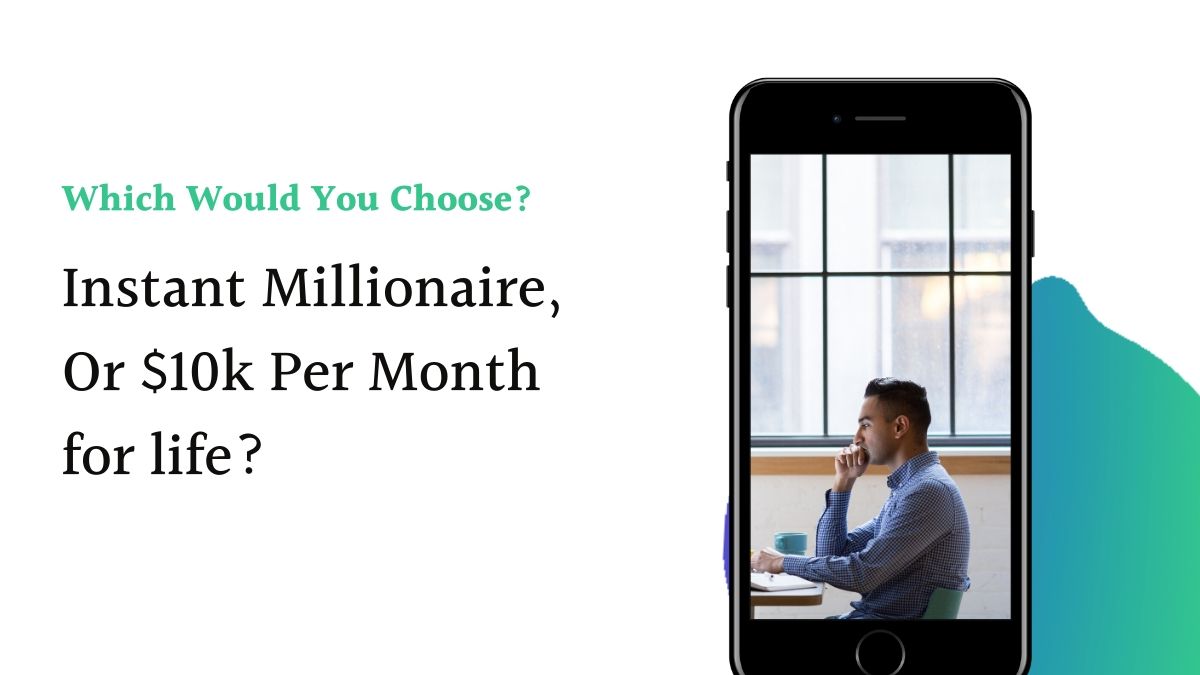
It’s an interesting question isn’t it. Would you rather be an instant millionaire, or take $10k per month for life?
It was asked in a group I belong to and a lot of people chose the $10,000 per month option. Very few said “instant millionaire” like I did, and many were curious as to why I would.
So here is my initial response.
First, no one knows when they’re going to die. Planning for the future is great and all, but 10k a month would take you 8 years to make a million.
That’s a lot of missed opportunity.
Instant millionaire gives you cash flow options, and a bit of freedom to take action on some things. Also, if you become an instant millionaire you don’t go right into investing.
You would invest with 10k a month to build a million dollars. You become an instant millionaire, you look for cash flow and capital gains to safely retain and grow your wealth.
A lot of people who win the lotto and get inheritances go broke trying to invest.
Then I recounted a real life story of a friend who got a $3m inheritance and he’s grown it to over $35 million in the past 10 years. The only thing he invested in was himself. Education, knowledge…
A lot of people wanted to learn more, but there is a character limit on replies, so I’m writing this blog post. Enjoy.
Have you read the book Money: Master The Game by Tony Robbins? Or listened to wealth builders like Warren Buffett, Grant Cardone, Tai Lopez and others?
The first time I heard about that piece of advice is from Mark Cuban. He was doing an interview – and I don’t remember with whom, but that’s the BIG nugget I got out of the whole thing.
They were talking about immediate wealth, specifically people who win the lotto or come into a big inheritance and how a few years later a surprisingly large amount of them are broke.
The reason is that they have not been prepared or educated to have wealth, because they’ve been raised up in a system designed to teach the masses how to work.
The most common advice to build wealth is to invest, but when has the masses ever been taught to invest?
What happens is, they get a lot of wealth and they suddenly become investors without any knowledge or experience of how money works on that level so many of them lose it. They aren’t investing, they’re gambling.
On top of that they’re buying all of this stuff that are essentially liabilities if they’re not handled properly. Houses, cars, etc.
Instead of staying frugal, they become big spenders, without any accountability.
So they’re spending out of control, they’re gambling, and they’re taking on more liabilities, (things that require money to maintain), and the inevitable is that sooner or later, they end up broke and even in debt when the money runs out.
So what should you do with lump money when you become wealthy instantly?
This is would be MY plan if I became an instant millionaire, based on everything I’ve learned so far, and I will say that disclosure this is NOT intended to be financial advice.
I’m just sharing what my plan would be and what my thoughts are.
Why I Chose Instant Millionaire And What I Would Do With It
Instant Millionaire or $10,000 Per Month? What I would do…
1. Remain Frugal.
I would continue to live as you’ve been living. By all means, pay off your debts, maybe move into a bigger house if you need it, but be reasonable.
Paying off your debts would be something like school loans, arrears, maybe pay off the car, even the house if it’s not an exorbitant amount.
For example, let’s say you’ve got a $300k house and you still owe $200k or more, just hold off on that one for a bit because you really don’t want to use up too much of your money all in one shot.
Or pay off and close all but the oldest line of credit with any cards so as not to ruin your credit score.
You remain frugal to a. keep your monthly liabilities low and b. maintain/build your credit score.
Most people will increase their living expenses, you want to stay the same or decrease it.
2. DON’T quit your job
After paying off your debts, something interesting happens. Your job becomes an asset.
Most people live paycheck to paycheck because their job is a liability. Their living expenses is either just enough to maintain their lifestyle, or not enough to and they need “creative financing” to stay where they’re at. Miss one or two paychecks and they lose everything.
However, large influxes of money give you an opportunity to reduce your monthly liabilities.
For example, an opportunity with large cash influxes is doing a refinance with a principal payment and dramatically bringing down the monthly payment.
So let’s say the monthly mortgage is $1500 per month, you do a refinance to preferably a fixed rate, NOT taking any money out, but instead put down say $50,000 or $60,000 on the principal, and suddenly you don’t have $1500 per month to pay anymore, you have like $800 or $900 per month.
You just freed up $700 or $800 per month.
So, if you make $5,000 per month and you were having trouble keeping up, take away the student loan payment, excess credit card payment, the car payment, etc. and include a reduced mortgage payment, suddenly $5,000 isn’t a liability anymore, it’s an asset – a stream of income.
3. Set aside 2 years of living expenses.
For most people, they maintain a home with $5,000 per month. For some it’s more, for some it’s less, but set aside 24 month of expenses. Not bills, but expenses.
Eating out, hanging out, Netflix, Hulu, etc. Include the misc. stuff you spend money on each month, and put yourself on that budget.
So set aside $120,000, ($5,000 x 24) in an interest bearing account and leave it alone.
I would look for the highest available interest rate return, and an account that eliminates fees by maintaining a certain balance, and just let it appreciate over time, and let the interest compound.
4. Business-like banking structure.
This is something I actually adopted quite a while ago. I used to have a problem with overdrafts and stuff when I was younger, before I learned about money management and how to protect my money from predatory practices.
All of my money is held in a high-yielding interest account, that I call my holding account.
My goal with doing that is to make sure my money doesn’t lose value over time. There are no fees on the account and the interest compounds over time.
The more money in it, the more options become available, including higher returns which allows my money to continue to make money over time.
I have a separate account where I get paid. So my clients, gigs, etc. when I get paid, all deposit to that account. That’s my accounts receivable.
From there, the money that I make gets divided up into other areas.
The first, is another bank account with no overdraft protection or overdraft fees. The reason for that is because nobody should have access to or drafting back where I keep large sums of money.
This is accounts payable, a.k.a. bills and debts.
I calculate my monthly expenses for the following month and transfer the money to that account. Mortgage, car payment, insurance, cc payments, etc. Anything I need to pay the following money will be there, plus the minimum balance so that the monthly fees are eliminated.
You know how a lot of companies think they own you, like it’s their money? They don’t want a card, they want a bank account and routing number? That’s what this account is for.
Never give anyone direct access to your source. It’s bad enough that the bank has access to it.
Then I have a personal savings and a personal checking. The money for my personal savings go first, and what’s left over goes into my personal checking.
I grow my savings with programs that allow me to do things like forward the cash back to my savings, or roll over the amount up to the nearest dollar to my savings, and I have a monthly commitment to add to my savings.
Savings are for emergencies. Car breaks down, refrigerator stops working, etc. I’d take a part of what’s left over and continue to contribute to holding too.
If I followed the steps, all of my money is growing slowly over time and not losing value, and because I have less monthly liability I have a bit of money freedom to do things.
After I’ve contributed to everything to make sure my money grows and doesn’t lose value, the rest of the money is for whatever I want, but more importantly, it’s for investing in myself. finding a mentor, buying books, taking classes, learning and growing.
I’d learn about finance, business – maybe even start one.
THEN I would look at becoming an investor.
I know the cashflow quadrant says the goal is to become a business owner and investor as fast as possible, but the CQ assumes progression from employee and self-employed to business owner and investor. It assumes time for learning and experience over a period of time, usually years.
If wealth is just dropped in your lap though, ASAP is dangerous. There’s no way to skip learning and having experience.
So if it happened to me, MY GOAL would be to first make sure that my new wealth continues to grow and is protected, second turn my existing income into as asset by reducing my monthly liabilities, third create an income buffer to hedge against economic disaster.
I chose 24 months, because the ’08 ’09 crash was pretty bad and left me out of work for 18 months, and it took about 4-6 months for me to get a business going to where I didn’t have to worry about immediate money problems – so 24 months.
Fourth? I would focus on growing as a person and learning finance and business.
If time was a problem, I would go from full time to part time hours with my clients and free up that time, but I wouldn’t quit my clients. This will prevent me from relying on my holdings to live on.
The 5th step would be to then start investing, and I would invest in cashflow opportunities primarily to rapidly grow my holdings.
I’d want to not lose money at all, but grow it.
I would let go of my clients ONLY when I have another income stream that would maintain my lifestyle, and I needed the time freedom to do other things.
Even then, I would probably incorporate, and hire someone to do the work for me so that I don’t lose that income stream. And after incorporating I’d restructure my banking to further protect my wealth and lower my tax footprint.
Come June 12th 2020, I will have been working from home full time for 8 years. That’s from not knowing ANYTHING about business or finance at all, so I’d probably maintain for 3-5 years before moving away from doing the fulfillment for clients personally.
I’m 41 right now – will be 42 in November. So by 47, life would be my oyster. I’d be able to do what I want, go where I want, help who I want. Pursue other passions.
$10k a month isn’t enough for me to pursue my calling in life. I need to grow wealth in order to fulfill that which I see as my purpose and help those that my calling will help.
I was involved in a brief conversation with a group of people online, when one of them said something odd; rather, it was odd to me.
He’s a slightly-above minimum worker, and after taxes he takes home around $1200 per month. He said, “working from home and making $1200 per month isn’t a lot“.
PS: No, this has nothing to do with the 1-time $1200 stimulus that some people are going to get. Some people tried to make a connection because of the number 1200, but that is unrelated.
Traditionally, he’s right, but here’s something to think about – $1200 per month when you work from home goes a lot further than when you make the same amount on a regular job.
That’s because working a regular job comes with overhead expenses that working from home does not.
The big one is commuting, specifically gas money.
Come June 12th this year, I will have been working from home for 8 years, and when I transitioned to working from home, I saved about $250 a month in gas instantly.
When I no longer had a car, I saved even more money because I didn’t have car payments, auto insurance, tax and tags, or maintenance.
A good friend of mine who made the transition to working from home? He sold his car and bought a motorcycle. He says that saved him about $500 per month.
There are also little things that add up that most people don’t think about. For example, when you work from home you do less laundry, and you for those who have dry cleaning, that bill goes away.
Also, working from home people tend to spend less on food. Some people only spend money on restaurants, vending machines, and so on because they’re at work.
The only up-tick in spending would be for utilities. Maybe an upgraded internet plan or phone service plan.
The other big saving is time.
Most people don’t realize how much a traditional job impacts their schedules, so let me ask you a question.
Would you go to bed the same time you do, or even wake up in the morning at the same time you currently do, if you didn’t have to get enough sleep, or wake up in time to get ready to go to work?
For many people, the answer to that is no; and if you’re one of those people who can’t wait for the weekend so you can either stay up later or sleep in the next morning, you’re one of those people.
Time is a valuable asset; the only one you can’t get back in fact.
Added to that, if you no longer have to commute, depending on how long your commute is, you can get some of your time back immediately.
My longest commute was 2 hours in one direction.
I was working on a construction site and there was always heavy traffic in the heart of the city. Not commuting gave me back 6 hours!
That’s four hours travel time to and from the job, and then the extra hour I used to got to bed, and the extra hour I slept in because I didn’t have to wake up early.
Then there was the passive time in between. I didn’t have to get dressed, eat a fast breakfast, then rush out the door.
Getting rid of that morning rush and sleeping in that extra hour was well-worth working from home.
Now, don’t get me wrong. I’m not saying settle for $1200 per month.
What I am saying is, don’t be blind to the benefits and possibilities of what working from home.
If you didn’t have to commute for your job, would you even own a car?
I know some people who only own a car for there job. In fact, I know a few people that don’t even like driving, but they have to for work.
Also, who doesn’t want a little bit more time during the day, even if it is to sleep in an extra hour every morning.
But here is the opportunity.
I know people who took that extra couple of hours a day to do things like upgrade their certifications, get a degree, learn a new skill, or start a business on the side.
Not having the time to do something is one of the biggest set backs people face, and there are decent opportunities out there for people who want to go get it.
There is freelancing and consulting, (both of which I do), and there are business opportunities ready to go with monthly costs, (which I also do).
Some of them can cost anywhere from $25 to $200 bucks per month, and I personally know people who is making and extra $1,000 per month or more from them.
Big disclaimer here… I’m not saying you will make money from any opportunity. Let’s be real here.
Nothing is guaranteed, and if you venture out and start your own business, there are both risks and circumstances beyond your control.
That being said though, the opportunities out are there for the taking if you want to pursue them. Just make sure and do your homework.
Anyway, with $1,000 per month, you can see we’re not talking about making big 6-figures or 7-figures that you’ll hear people talking about. Even smaller amounts can be significant success.
For most people, an extra $500, $600, $700 a month is a whole new lifestyle. That’s their car payment + insurance, a chunk of their rent or mortgage, their health insurance.
I know two people who were finally able to pay off their credit card debt and start saving the way they always wanted to, all because they had one monthly debt covered with a little bit of extra income.
I even know some people personally, who are living like proverbially kings on just $60,000 a year.
They were able to afford the lifestyle they wanted, and it started with them working from home and using that extra time and money they were saving wisely.
This pandemic.
If you’re one of the people blessed enough to work for a company that keeps you employed and you’re working from home, for all of the bad happening, this can be an amazing opportunity for you and your family.
If you’re one of the people out of word, this can still be an opportunity for you. You may not want to jump into any kind of paid business opportunity, but there are some really great ways you can take what you know and turn it into an income stream.
Whether you’re working from home or unemployed because of the pandemic, think about this.
What did you do for your job? All of your skills, your talents, and your knowledge. What did your job entail? What did you have to do? What did you have to know?
Mindset: A new perspective
If your employer was willing to pay you money to do what you do and leverage your skills, talents and knowledge for themselves, how many other people would be willing to pay you to do the same for them too?
That’s big, right?
I mean, there are hundreds, even thousands and tens of thousands of entrepreneurs and small businesses all over the country that can’t afford to hire people or keep a staff, but they are still willing to pay every day people just like you for your skills.
If you were able to take your skills, your talents, and your knowledge, package them up a little bit differently – catering to those people, (the entrepreneurs and the small businesses), you can start making money.
A lot of freelance sites like Fiverr, Upwork, and Funnel Rolodex, (one of my personal favorites), allow you to register, create jobs, (what we call gigs), set your price or hourly rate, then list them for entrepreneurs and small businesses.
You will have to learn a little bit how about to present yourself to be more appealing, maybe even learn how to create irresistible offers, and even go through some trial and error to start making progress, but when you do get it, you’ll start seeing little hits of cash come in.
For me, when I started, it was $5 bucks here, $10 bucks there. Then I’d get $25 here and $50 there. A quick $100 bucks one day, $250 another.
It doesn’t sound like much, but trust me when I say it ads up.
I kept at it. I kept working and improving, and soon enough I was landing $1,000 per month clients.
Here’s Some Proof
I am not one for flashing cash. I think it’s “gimmicky” and a bit dangerous even, however, I also believe in transparency and integrity, which means, if I am going to teach you how to make money from home, I better well be making money from home myself using the same exact methods I’m telling you about.
Also, a bit of a disclaimer (again). What you’re about to see are my personal results and it in no way guarantees that you will get the same results.
That being said, I wanted to share some results from my PayPal account – where I invoice and receive payments from clients.
The first thing you’ll notice is that I blacked out the names of the clients, for obvious reasons. The second thing you’ll notice is that this is all from this year.
This first one is payments received from January to March, ($2,290.40).
These two are invoices paid for February and March, (another $1,910). Notice that these were paid and there were no fees taken out.
And finally, this is an invoice that hasn’t yet been paid, (and I’m confident that it will be), for $1,885.00
If you’re doing the math, just from freelancing, that’s $6,085.40 in three months, which is a little over $2,028 per month.
Another way I make money is with affiliate marketing; that is selling other people’s products and services, and earning a commission when the customer buys.
Because I’m a programmer and an engineer, I resell hosting plans for the company where I host my stuff – again, integrity is important to me so I won’t sell anything I don’t use myself.
It doesn’t happen very often, but when a client asks me for hosting I recommend them. Check this out.
There’s only one customer there, but it’s almost $50 bucks per month recurring – and that is just one affiliate program I am a part of.
Obviously I’m not rolling in deep pockets, but an extra $2,000 per month ain’t bad at all considering I literally work on my bed with a laptop and a cellphone, putting in 20-30 hours per week.
… and remember. I don’t have a car payment, or car insurance payment, have to fill up every week, or anything like that.
Anyway, there are other ways I make money too, and as the year goes by there will be more clients, more gigs, and more commissions and my income will increase, but more importantly…
I hope you get the idea; or at least starting to.
Just because the pandemic has you working from home, or even out of work, it doesn’t mean that there isn’t opportunity to make money, or even get ahead.
All you really need is a little bit of knowledge and maybe some guidance to help you get started.
How Do I Learn More & Get Started?
This is the cool part.
There are two really great resources that I’ve brought together to help you make the absolute most of making money education, and strategy that you can actually use to start making money right now.
And they’re both free…
The first one is a free book that will teach you all about what you were just introduced to – how to take your knowledge, your skills, and your talents, and turn them into money.
It’s perfect for those who need to make money from home and it is a treasured resource in my personal library. Yes – integrity – this book has been invaluable to helping me get where I am.
The second one is a free guide that I’ve written to help you accelerate the process so you can start making money sooner.
The first book isn’t that long. It’s about 300 pages and you can read it in a weekend if you so desired, but, I know first hand that it may take longer for some people.
So the guide that I wrote is kind of a “crash course” in how to make money from home, complete with a big picture overview of freelancing and entrepreneurship, coupled with some powerful advice, as well as simple ideas you can use to start making money from home very quickly.
Here’s how you get both of them.
Step 1: Follow the link and get your free book, (all you have to do is pay for shipping).
John Wooden‘s incredible TED Talk from March 2009, speaking on the difference between winning and succeeding. With profound simplicity, Coach John Wooden redefines success and urges us all to pursue the best in ourselves. In this inspiring talk he shares the advice he gave his players at UCLA, quotes poetry and remembers his father’s wisdom.
Backstory. This article stems from a reply on a video by Beau of the Fifth Column sharing his thoughts on Patty Hearst, the homeless, and pitchforks.
In the video he uses an example of Jeff Bezos and what he could accomplish if he used his net worth to directly affect homelessness, and I disagreed with the premise itself because it failed to consider a few things, for example the 300,000 plus employees that would be out of work at just one of his companies.
The conversation turned toward financial intelligence and wealth inequality and I took the time to explain a lot of the things that I learned on my journey to achieve financial freedom (wealth).
I’ve included the video here for you to enjoy, but most importantly, I decided to share some of the financial advice that I learned along the way, and I hope that they will help you as much as they helped me.
Leave me a comment below and let me know what you thought. Which piece of advice was most relevant to you?
Financial Rules I With They Taught Me In School
1. Stop caring where your money comes from. There are many ways to make money, but people tend to limit themselves to making money only from one way.
We hear it all the time, for example, “you want to make money? Get a job“. That is absolutely ridiculous thinking that leads to poverty.
As long as it’s legal and ethical, I don’t care where my money comes from. That was the hardest lesson for me.
2. The wealthy are wealthy because the find two or three ways to make money doing what they’re already doing.
This is a really important one because most people only get 1 paycheck. What if you could make 2 or 3 or more?
For example, I run a music business. I was teaching music privately. That was one paycheck.
Then I wrote a book teaching music theory. I did the work once and it pays over and over again. That’s two paychecks.
Then I started a music blog syndicating news from other sources and I earn money on advertising AND I receive a commission for music sales.
That’s two more paychecks.
I’m in the process of creating different products and services to sell. That’s two or three more paychecks.
I do the work ONCE and I get paid over and over and over. I turned one paycheck into many paychecks, and I didn’t have to take on any large time commitments.
That skill is important because of this next one.
3. The game of wealth boils down to having more assets than liabilities. To simplify this, at the end of the day an asset is anything that puts money in your pocket, and a liability is anything that takes money out of your pocket.
Owning a home is a liability. It continues to cost you money. Maintenance and upkeep, mortgage, taxes…
The value, (financially speaking), is the equity, which isn’t worth anything until you sell your home, (there is an important lesson about this coming up).
Your car is a liability too.
Your home and car are obvious liabilities, but there is also a liability that most people don’t recognize – their jobs! That’s right, your job can become a liability.
Your job is an asset as long as it pays more than the liability.
It costs money to have a job. You have to pay for clothes, (some people pay for uniforms), some have union dues, gotta pay for gas and maintain your ride, transit if you don’t have one, you have withholdings for taxes, etc.
In order to have a job, you need a place to live, and a working telephone, and a way to get there. This by the way is why homeless people can’t just go out and get a job. It takes a lot more than a shower, a haircut and good clothes.
All of the things needed to find and maintain a job are liabilities.
This is why companies will lay off employees. When productivity drops, employees are still costing them money, (maintaining safety standards, retirement and health insurance contributions, and more).
TIP: If you have a job, the BEST way to keep it, or get a raise, is to show your employer that you’re an asset, not a liability.
So, at the end of the day, if you are making MORE money than the liabilities you have, your job is an asset.
If it’s not covering everything, it’s a liability. You still have to pay to keep your job, but it’s no longer covering everything.
The solution most people have is to decrease their lifestyle. They’ll cut back, try to save. Those are SHORT TERM solutions. The long term solution isn’t to decrease your lifestyle, it’s to INCREASE your income.
Getting a second job, putting in more hours… those are also short term solutions because you’re trading time for money, and you only have so much energy and so much hours in the day, and if you fall sick or die?
Game over.
You have to create more income. This is where #1 and #2 come in. You have to stop caring where the money comes from, only that it’s legal and ethical, and you have to find more ways to make money doing what you’re already doing.
The game of wealth is this. Have more assets than liabilities.
Addressing the previous point where I said there is a lesson coming up, here are three guidelines the wealth use for HOW they spend money.
4. They understand that all money is someone else’s money. The only reason to build wealth is to spend it. It’s not your money. You’re only holding on to it to give to someone else for something of value.
You have to start thinking in terms of, “what will I trade this money for?“. If you’re saving for retirement, the money belongs to the people you’re going to trade it to for what you need – the electric company, healthcare, etc.
ALL money is someone else’s money. We have to lose the idea that it’s “my” money.
Jeff Bezos for example, has a huge net worth. But that’s not his money. That’s his employee’s money, and the power company’s money, and his investors’ money, and his affiliates’ money, and everyone else that he spends money on. That is their money. It’s not his.
Divorce from the idea that we own money. We don’t. Money is just a tool that we hold on to for someone else.
5. This is the big one – Money only has value when it’s used.
You got a million dollars in the bank? You don’t have anything of value until you spend it. Until then, it’s just ones and zeros on a screen, numbers in a register, or numbers printed on a piece of paper.
It will do nothing for you until you use it. And if you just let it sit there, it devalues over time, so you end up with less money than you started with.
You have to put money to work. If you don’t use it, you will lose it.
Like your home. Equity does you no good until you use it. If your home is a liability, one of the best ways to turn it into an asset, is to rent or lease it out.
You’ll learn this about the wealthy. They rent where they live, and own what they rent.
Did you know, that for the same cost as a traditional home, you could get a commercial building?
A lot of real estate investors start out, not buy buying a home, but buying a small apartment complex for roughly the same amount of money. They will live in one of the units and rent out the others.
They still got their mortgage payments, except now they have tenants, and they’re making more money than the payments on the building and if it’s done correctly, they essentially live in their own building rent free.
Each rented apartment is a stream of income, and they continue to work their jobs. So if instead of a house you get a duplex, live in one, and rent out the other.
I’m not saying go out and do that. I’m using that as an example. There’s a whole LOT to learn about real estate investing that you should learn.
Okay, I lied. I’m sorry. You’re not getting 5 rules. You’re getting 6.
6. Outside of necessities, don’t spend money unless there is a tax benefit, makes you money, or has the potential to make money.
That third one is a book when you break it down. Bottom line, you have to become money smart, and apply the strategies that opens the door to new opportunities.
In other words, before you spend money on something, ask yourself, “is this a liability or an asset? Can it become an asset?“.
When you think in terms of assets and liabilities, and only spend money when it benefits you, (a tax benefit, makes you more money, or has the potential to make money), you’ll find that you have a lot more resources than you think you do.
As a BONUS, I’ll share with you something that literally changed my life.
It’s a financial lesson that I received on a Monday night call with someone who I watched make over a million dollars over the course of 8 months to a year, from scratch. It’s always stuck with me.
He said, “Your bank account doesn’t reflect who you are, but who you are being and your thoughts about money“.
Wealth is a mindset and money game that anyone can play, and quite frankly, should play.
Recommended Reading
On the topic of money, there is a book I highly recommend. It’s called Money Master The Game by Tony Robbins. It was instrumental in helping me transition from working a job to running my own business at home, and is continuing to help me as I work toward building wealth.
Figuring out how much your dream life costs is a very important step on the road to success that many entrepreneurs often skip.
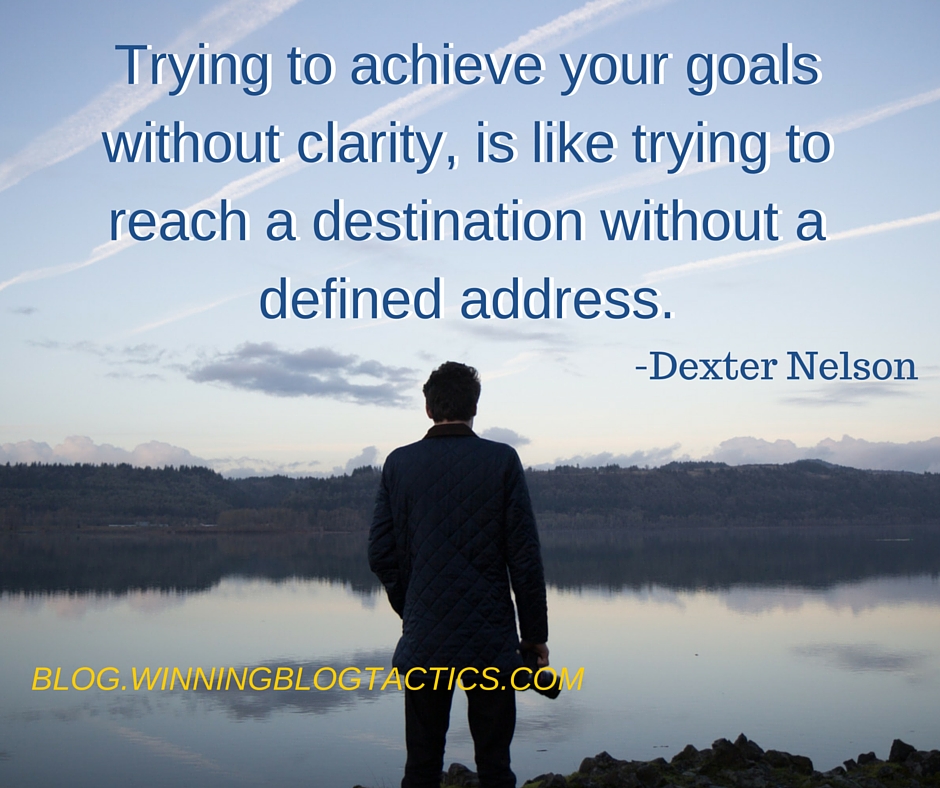
On a recent Facebook post, I talked about goal clarity sharing how being precise and being clear is important.
I highly recommend that you take the time to read it.
To Summarize…
A lot of people tend to be pretty generic about their goals. They’ll say things like, “I want to be rich,” or “I want a dream home” without being specific.
For a long time I said, “I want to make a six figure income” and had no clue what that entailed.
A six figure income can be anything from $100,000.00 dollars to $999,999.00 dollars — That is a really big gap.
There’s nothing wrong with big dreams, but in order to achieve those dreams you have to be specific, and you have to be clear about your goals.
Why Specifics?
Because success is created in the actions you take every day. Success is created over time in the actions you take every day.
If you don’t have goal clarity, you’ll end up with results you don’t want, or miss your dreams entirely.
To use a more understandable example:
Without being clear on your goals, it’s like trying to use your GPS without an end destination.
Your GPS can give you directions, but it has to know where you want to go first.
Figuring out how much your dream life costs? That’s important.
So, do you know how much your dream life costs?
Here is a simple exercise you can do right now.
First, put yourself in the mindset that money is no object. Allow yourself to be a position where you can get whatever you want..
Now picture your dream home. How many bedrooms does it have? How many bathrooms? Do you want land? If so, how many acres? Does it have a pool? A basement? What city do you want to live in?
Really sit down and picture what you want for your house.
Then? Go to a site like homes.com or realtor.com and search for your home. How much does it cost? What are the mortgage payments like?
Write it down!
Next? Do the same for your dream car. Is it a truck? Sedan? A sports coupe or luxury car? What color. What features do you want in it?
Got it pictured?
Now go to a site like autotrader.com and search for your car. How much does it cost? How much are the monthly payments?
Yup. Write it down!
Next, do you want to travel? Picture your dream vacation.
Where are you going? Are you flying or going for a road trip? What kind of hotel are you staying in? Or is it a condo?
Are you there for a weekend, a week or longer?
Now, go to a vacation research site like tours.com, or a travel research site like travel.com and find out how much your dream vacation costs.
Are you travelling once per year? Once every 3 or 4 months?
Remember, money is no object.
You guessed it. Write it down!
Having all of those things is great, but what about keeping and maintaining them?
You have to furnish that house. You’ll have utilities to pay. You’ll have to eat.
Speaking of which, how would you eat?
If you were to go grocery shopping right now and be able to buy the healthiest food possible, how much would it cost you?
Next time you go grocery shopping, come up with an estimate and write that down too.
What about your other expenses, like health insurance? Or even entertainment?
Of course, these would be rough estimates of how much you would spend, but with a bit of research, you can get fairly accurate. Write it down!
Now… here’s where the cool part comes in.
Now that you have estimated monthly costs for your house, car, and travel, plus other expenses, add them all together.
Then add 30% of that total.
That’s how much money you need to make every month to live your dream life!
A lot of people think that they’d be okay with an extra $1,000 or $2,000 dollars a month, but in reality, they’ve never stopped and actually figured out how much their dream life will actually cost them.
Goal Clarity
Now that you have a very specific income level to reach, what you want is probably a lot more real to you. Now all you’re missing is goal clarity – figuring out what you are going to do every day to achieve your income goal.
For me, my goal was pretty low.
My highest paying job ever was $78,000 a year, so I knew that if I made that, I’d be happy. Things were pretty good for me when I made that amount of money, so when I set my goal, it was $6,500 a month.
I was sure that if I could find a way to replace my income I would be happy – and then I did that very same exercise I just told you to do and I was shocked!
It turns out that in order to live the life of my dreams, I would have to make $13,130.00 per month. That’s $157,560.00 per year, which meant that my best paying job of $78,000 per year – 40+ hours a week? I would have had to do twice!
80+ hours a week doesn’t sound like something I would want to do for the rest of my life!
How about you?
Multiply your monthly income by 12 to get an annual income amount, then divide it by your current annual income to how how many of your current job you need in order to make the kind of money you need to live the life of your dreams.
A friend of mine realized he needed to work 5 and a half of his jobs in order to live the life of his dreams. Another friend, he had to work his job 9 times!
What about you? How many times would you have to work your job?
The Game Plan
At this point, you ca stop reading. Honestly, you can. However, if you want to learn more about my solution, keep reading.
So you are now clear on your dreams, and you have some goal clarity on where you need to go.
What you’re missing now, is a system to get you there, and a daily action plan with steps you can follow to achieve your goals.
Obviously, for most people, working a job, or a second job, or a part time job will NOT get them to where they want to be.
The only option is to do something different – and the answer is to start a business. Become an entrepreneur.
Don’t freak out!
Thanks to the age we are living in today, working at home and starting a business, even on the side (if you have a full time job, or family responsibilities), has never been easier.
From being a full time uncle, losing my business, and hitting rock bottom. Basically starting my life over and having to rely on family to keep the end met.
Everyone’s situation is different. You may not even be facing hard times, but certainly you want more. You want the best life possible for you and your family, and after that exercise, you know EXACTLY how much is costs.
All you need now, is a game plan.
Goal clarity is the ability to set clear goals, so that you can take actionable steps to achieve them.
So, today we did this exercise where we were challenged to figure out exactly what we want in life — what is the reason why we’re even building a business in the first place.
(And by “we” I mean our entrepreneur group).
Anyway, the way we were instructed to help us figure that out was to close our eyes and imagine our perfect day, then describe it.
Anyway, I wanted to share this with you guys, and also, challenge you all to do the same. It’s a really good exercise to help you figure out what it is that you want and where you want to go.
My Perfect Day
I’m slowly getting into the habit of writing down goals and dreams and visions, and it’s funny. For all of the things I want to accomplish, my perfect day is really simple.
I paused the video, grabbed a pen and pad and spent a good hour just thinking about just what the heck I want, and with everything I wrote down, there are just two things, and they’re so simple.
My perfect day is being able to sit at home and hang out with my family and friends, and have the time and freedom to travel with my dad and not have to worry about or even think about money.
We’re immigrants and I watched my parents sacrifice and sacrifice and sacrifice for me and my sisters. My dad has been that unmovable rock my entire life. There is no quit in him.
The past few months I’ve been hearing him talk about being tired of working and want to do other things with his life now that the kids are grown and he’s done all he has to do for us.
He and I are always talking about taking a trip together. No destination specifically, just travel and see places we lived, track down old friends and neighbors, and just free up ourselves.
I REALLY want to retire him and give him that. I’m almost crying just thinking about how awesome that will be for him, when I tell him it’s okay for him to retire.
“Don’t worry about the bills and don’t worry about the house. I paid it off.”
Giving him that gift? Oh man!
The other thing is my music. Music saved my life. I was headed down a very different path when I was younger.
I was angry at the world and bitter and didn’t have many friends and I was ALWAYS fighting and getting into trouble.
6th grade wheel program. Dr. Float. She introduced me to the double bass, and some much needed discipline. I don’t know where I’d be today if it weren’t for her and the orchestra.
I can sit around all day and just play my double bass by myself and the world can pass me by and I’ll be as happy as a bird whistling on a window sill. Me and my sisters used to play as a quartet too at churches.
Get this.
My big sister plays the violin, I play the bass, my younger sister below me played the viola, and my baby sister played the cello. I MISS those days when we played and practiced together.
I’m DEFINITELY starting a string quartet. And I have published music I’ve composed (classical) that I’ve never heard performed live.
Looking ahead I can see myself owning a club with a live venue. And I can see that little string quartet I’m funding with my commissions from Empower Network doing shows and concerts for charity too.
Every year with the orchestra we did 4 or 5 big concerts or holidays or whatever, but the one that really got everyone together? The Teddy Bear’s Concert!
It was a free concert for the community and it was usually between Thanksgiving and Christmas right? Like November’ish.
Anyway, people used to bring teddy bears and other gifts for kids, and the whole community used to come together.
Yeah, I gotta start an orchestra and hold my own Teddy Bear’s Concert every year for the community.
That’s a must.
All the other “stuff” just pales in comparison.
That’s what I wrote.
I had this really long list of things that I wrote, and it started out with material things like the car I wanted and how much money I wanted to make and everything else.
All that was great, but when it got right down to it, I still had to answer the question, “why do I want all this ‘stuff’? What do I get when I have it all?”
Then I threw the list away and started picturing what my perfect day would be, and that’s when I discovered what it is I truly want.
…
If you’re still reading all of this I truly appreciate you. I ramble and get long winded so yeah — I appreciate you.
Listen.
If you are trying to figure out exactly what it is you want out of life, and more importantly how you’re going to get there, I would suggest that you start by first figuring out your WHY.
There’s more to life than just going to work and paying bills for 40 years then hoping that you can retire some day.
But you’ve got to figure out first what you actually want.
Once you figure that out, then you need to figure out how you’re going to get from where you are right now, to where you want to be.
That is where I think I can help you.
You need a vehicle that you can drive to get from point a to point b and the vehicle you choose has to be the right one.
If I have to travel 1,000 miles I’m not going to use a skateboard or a bicycle. That’s just way too slow. I want a car, and the faster it goes the better.
Or better yet, I’m gonna fly, right?
I am building my business from home currently, by blogging.
I’ve been able to build strategies around syndication, writing on viral topics, and more. I’m earning money passively through AdSense, paid ad placements, as well as promoting affiliate products and earning commissions.
I am putting together a free guide on how you can do the same.