Category: Articles

Articles and stories

  • 30 Days of Faith: Are We All Going To Hell? (Day 6)

    30 Days of Faith: Are We All Going To Hell? (Day 6)

    So, I was listening to Cliffe Knecthle, a pastor and apologist speak on the question, “are we all going to Hell?” I have to admit, I wasn’t happy with his answer, which you can see here.

    Don’t get me wrong, what he said was correct, however, I feel that it was also incomplete because while it answered the question, it didn’t give the full answer that a person seeking Christ would need to understand, (or even an existing believer who simply doesn’t know).

    So this post today is to answer the question, are we all going to Hell, in a biblical way, and I hope it makes sense.

    Warning: This is a topic that stirs a lot of emotions, so please read all the way through before rebutting. I promise you it will make sense by the time you finish,

    So, the first thing you need to understand is that nobody goes to hell because of sin – we are all, **already** on our way to hell — I know. That’s a very bold statement.

    Does you know John 3:16? – “for God so love the world that He gave His Only Begotten Son that whosoever believes in Him should not perish but have everlasting life?

    Most people do. It’s probably the most common verse that kids memorize, but have you read versed 16 and 17?

    They say, “For God sent not His Son into the world to condemn the world, but that the world through Him might be saved. He that believes is not condemned, but he that does not believe is *condemned already** because he didn’t believe in the name of the only Begotten Son of God.

    You get that? We are condemned – already.

    See, the path of condemnation was set long ago before any of us were born because sin entered the world and it infected every human being that was ever born and that will ever be born.

    Put another way, we are not born into the land of the living on our way to the dying. We are born into the land of the dying on our way to the land of the living – eternity.

    And the proof that we are in the land of the dying is that we will die. Nobody gets out of this life alive. We do not have forever in this life.

    We will in the next, but not this one, and because of circumstances beyond any of us, all roads lead to Hell unless we choose to believe in the name of Jesus Christ.

    Because sin entered the world, it corrupted our natural state, so we aren’t born good – we are born innocent.

    But because we have a sin nature – that is, the inclination and proclivity to sin, our state of being is unacceptable for admittance into heaven.

    Put another way, not all of us are as bad as we can be, but by default, all of us have been bad enough that we cannot be perfected in the eyes of God without help.

    So, how do we become perfect? Where does the help come from that we need in order to be seen as righteous before God?

    Enter, Jesus Christ.

    The work that Jesus did on the earth did something amazing- it paid the eternal sin debt that was that was hanging over our heads.

    Now, I won’t quote all of it, but if you read Romans 5: verses 12-19, it begins, “Wherefore, as by one man sin entered into the world, and death by sin; and so death passed upon all men, for that all have sinned“.

    That was speaking of Adam and the sin in the garden. Notice that it says sin caused death, and death was passed to all man (mankind). So sin was inherited, like a genetic disease.

    But when you continue to read, verse 19 says, “For as by one man’s disobedience (speaking of Adam) many were made sinners, so by the obedience of one shall many be made righteous.

    That’s speaking of Jesus Christ.

    His life, death, burial, resurrection and ascension, did something amazing – it paid the debt owed by mankind to God, and then it reconciled us to God.

    2 Corinthians 5:18-19, says “All this is from God, who reconciled us to Himself through Christ and gave us the ministry of reconciliation.

    What Jesus did was free us from sin and death, so we can be reconciled to God. Sin drove a wedge between us and God.

    And if you want to know why hell is eternal? It’s because God is eternal, and sin is an eternal crime against an eternal God, so the judgement must also be eternal.

    The good news is Jesus Christ.

    Romans 8:1-4 “Therefore, there is now no condemnation for those who are in Christ Jesus. For in Christ Jesus the law of the Spirit of life set you free from the law of sin and death. For what the law was powerless to do in that it was weakened by the flesh, God did by sending His own Son in the likeness of sinful man, as an offering for sin. He thus condemned sin in the flesh, so that the righteous standard of the law might be fulfilled in us, who do not walk according to the flesh but according to the Spirit.

    And the moment we accept Christ, we receive the Holy Spirit in us. For reference, Corinthians 12:13, Romans 8:9, and Ephesian 1:13-14.

    And after we have received Christ, Jesus begins working in us, by the power of the Holy Spirit so that we become more Christ-like.

    In fact, He gives us a new identity – the bible calls believers saints, not sinners. Beloved and not enemies. Sons and daughters, not strangers.

    So, to answer the question, does everyone go to hell if they aren’t saved? Yes. But it’s not because we’re bad or wicked or evil.

    It’s because we’re already on our way to hell unless we accept Christ as our Lord and savior — which He offers as a free gift, by the way.

    On more thing…

    If you’re yet a believer in Christ and would like to know more, there’s a great resource you should check out where you can get to know all about Jesus, His work, and salvation.

    Click here >>

  • 30 Days of Faith: Don’t Worry. Be… Joyous? (Day 5)

    30 Days of Faith: Don’t Worry. Be… Joyous? (Day 5)

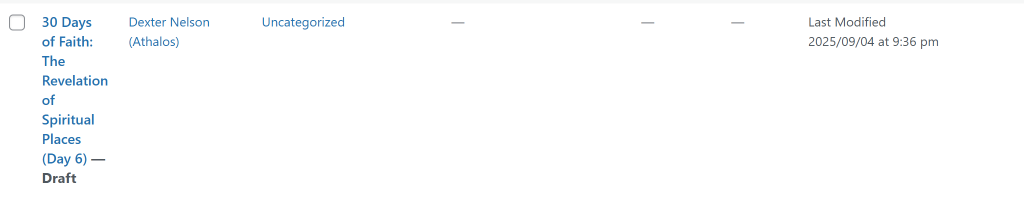
    I draft out my posts, when possible, days ahead of time, and I drafted out two – this one on worry and joy, and another on heavenly places last week., and another on know, I know! That’s not how the song goes. But here’s the thing – joy is far better than happy.

    I know that’s easy to say, so I’ll show you. This is this post that I’m writing now, (notice the last modified date).

    And this is the second one I mentioned. Similarly, look at the last modified date.

    The last week has been very eventful. A lot has happened, good and bad, and I’m glad that I didn’t post these back then when I wanted to because God has an interesting sense of timing, and the context of what I would have written changed, because we’re all coming from a different perspective.

    I was actually feeling guilty that I didn’t post, because for me this is day #14 of my 30 Days of Faith, and everyone else who was looking forward to the series is only now getting Day #5, but I believe now there was purpose in it.

    Let’s talk about worry…

    For a lot of people, they would be joyous if there wasn’t so much to worry about. Life has a way of creeping in and filling our spaces with sicknesses, financial obligations, adversarial people, tragedy, and all kinds of situations and circumstances that not only distract us, but demand and command our attention, and robs us of our focus.

    And as soon as we think we’ve got a handle on things, there is sure to be something else, and there is always something else.

    So, how do you stop worrying?

    There was a very timely sermon from Tony Evans today that I want to share, but before I do I want to share two very important principles that will help you to not worry, but also empower you in a way that affects your whole life.

    Principle 1: Worry Is A Sin.

    I know that’s a strong statement to make but it really is. Over and over again in the bible we are warned to not worry because God will provide and keep His promises.

    Matthew 6:25 tells us not to worry about your life, what you will eat or drink; or about your body. And then in verse 34 of that same chapter it says do not worry about tomorrow.

    In Luke 12:24-28, we’re told to consider the ravens and the flowers, how they never have to toil and God provides.

    Throughout the bible, the solution for worry is to trust God, and worrying shows that we don’t trust God to keep His promises, but more than that, it means that we were looking to someone or something else for our provision.

    And when you look to anything else for provision, that is idolatry. So for me, worry is rooted in sin, and I repent of it.

    Now, that leads to the second principle.

    Principle 2: Who Is Your Source?

    If you really understand this principle, it will change the direction of your future. Now that you know worry is a sin the next question is, how do you stop from worrying? Because as we said, life keeps coming and there’s always something else.

    Here it is – Don’t just trust God to provide; Make God your only source.

    Put God in a position to where He’s the first person you ask, and give Him the final say in everything you do. Make Him the highest and ultimate authority.

    When you make God your only source for everything; when you structure your life so that God is over everything like finances, health, relationships, and everything else – everything and everyone else becomes a resource that God uses to fulfill His promises and provides.

    Suddenly, your boss at work can’t hold your paycheck over your head because your job and your boss isn’t the source of your income. God is. He’s just using the job and your boss to provide.

    When you’re sick, a diagnosis can’t be held over your head because the doctors and the hospital aren’t your source of health. God is. He’s just using the hospital and the doctors to provide.

    Understand that when you put Jesus Christ as the first and last authority in your life, if the Father says yes, then the world can’t say no, because they do not have the final say. God does, and if you’re living in such a way that you’re in alignment with Christ, the Lord will provide.

    Now, don’t get me wrong. There are concerns that we will have, but those concerns will never escalate and become worries because you have a heavenly Father that always keeps His word. So believe Him, and live out that belief.

    That is what we call faith – believing God. Or, as once was said by Tony Evans, “faith is acting as if it is so, even if it’s not so, in order that it might be so, simply because God said so“.

    Stop worrying.

    An Exercise To Help With Worry.

    Now, it’s one thing to say worry is a sin, and it’s one thing to make God your source, but how do you actually deal with worry?

    One thing about me people notice is that I don’t worry about anything, ever… at all, and the thing that helped me to stop were the two principles I just shared, and a simple exercise that I created for myself.

    Basically, what I do is:

    • I pray to make sure I’m confessed and repented so that my sin doesn’t interfere with the relationship between me and Jesus. Sin gets in the way of that relationship so I want to make sure there is no personal sin that I haven’t dealt with.
    • I take out a piece of paper and I make a list of all of my problems; the troubles I’m facing, the challenges I have, and everything that is a concern., and then I make a list of my problems.
    • Once I’ve made my initial list, I take each item on the list and I write down things I think I can do to solve it. I really think here and put some effort into it.
    • Then, when I’m done with that, I pray over the list, asking God what He wants me to.
    • Then I make a list for each item about what I can do. Then I pray over the list and ask God to show me what He wants me to do.

    Sometimes the answer is on the list, sometimes it’s not, but whatever God says to do, I do, and if there is nothing I can do about it, I turn it over to Him, and I put it out of my mind. I trust God to take care of it.

    That way, I’m never thinking about problems. I always have something to do and I’m always trusting God above all.

    Now, the reason for me making a list and writing everything down is because one of my worry triggers was having too much in my head to think about. It was exhausting and many times left me more confused and frustrated than the problem itself.

    Making the list was my way of getting the noise out of my head so I could focus and think clearly, and at the end of the exercise it brought me peace because there were no “what if” or “what about”-type thoughts remaining. So, spend some time brainstorming on that solutions step where you think about everything you can do.

    The more time you spend there, the less of those kinds of thoughts you have.

    Sermon Time

    As I said, Tony Evans has a timely sermon this morning, and I was quite happy with it because it was on this topic, and honestly, that’s one of the reasons I knew that today was the right day to resume writing.

  • The Death of Racism: A Call To Bury Systema Naturae

    The Death of Racism: A Call To Bury Systema Naturae

    If you still think “race” when you think of a person’s skin color, your way thinking is almost 300 years out of date. In 1735, (290 years ago), Carl Linnaeus, a Swedish Biologist, divided humanity into four races largely by complexion.

    • Europeans = white
    • Africans = black
    • Asians = yellow
    • Native Americans = red

    Here’s the problem: his classifications have been proven wrong time and time again, and society has never gotten rid of them.

    There is only one race: The human race, and within it we carry extraordinary diversity.

    We are not different races. We are of different complexions.

    Complexion is defined as “the natural colour, texture, and appearance of a person’s skin, especially of the face“.

    So my mission, starting now, is to end racism – and the best way I know how is to finally do what should have been done 290 years ago: bury Carl Linnaeus’s classifications for humans based on complexion once and for all.

    And we’ll start with calling him out for what he was – the father of racial science.

    In 1735, when he published Systema Naturae, he didn’t just classify human beings. He attached temperaments and value judgments, and as a European intellectual in a colonial era, while he was obsessed with classifying things, he also reflected the stereotypes and hierarchies of the era of colonialism and transatlantic slavery, where Europeans at the top, others ranked lower.

    These are his classifications:

    • Homo Europaeus (white, governed by laws)
    • Homo Afer (black, governed by caprice)
    • Homo Asiaticus (yellow, governed by opinion)
    • Homo Americanus (red, governed by custom)

    What his Systema Naturae did was provide a scientific veneer, a covering, for ideas that were already being used in colonialism and slavery, and it gave a “natural order” justification to the inequalities Europeans had been enforcing since the 1600s.

    Linnaeus’ system may not have caused slavery, but it institutionalized race-thinking and gave it a framework that politicians, economists, and slaveholders could lean on.

    By the late 1700s and 1800s, his taxonomy fed directly into so-called “scientific racism,” which rationalized slavery, colonial exploitation, and segregation as being natural.

    It was this kind of thinking Darwin would use 124 years later in his work, Origin of the Species, (full title: On the Origin of Species by Means of Natural Selection, or the Preservation of Favoured Races in the Struggle for Life).

    It was this kind of thinking that Hitler would then use, starting in 1933 during the Holocaust and the Nazi Medical Trials to exterminate Jewish people.

    It’s this kind of thinking that Margaret Sanger would use, publishing and promoting Nazi propaganda about race and eugenics, as the basis to open abortion clinics in and around non-white communities of color.

    And it’s this kind of thinking that has infiltrated almost every level of society from politics and economics, to social systems and even medicine.

    Many in our medical industry still believe that:

    • Black patients feel less pain, or have thicker skin/nerve endings.
    • Black patients naturally have higher muscle mass and therefore higher kidney function.
    • Black and Asian patients have inherently lower lung capacity than whites.
    • Rashes, bruising, jaundice, cyanosis (oxygen loss) show up the same way on all skin tones.
    • Black patients are biologically predisposed to hypertension.
    • Black women’s bodies are “naturally” higher risk in childbirth.

    For the record: ALL OF THOSE ARE FALSE!

    Carl Linnaeus’ Systema Naturae has been at the heart of scientific racism for almost 300 years, and it has been at the heart of justifying racism based on complexion in all of it’s forms, and it has been used to justify murders, genocides, and countless atrocities and injustices throughout history.

    And it remains pervasive and problematic almost 300 years later, even though it’s been proven wrong over and over again, because those who peddle hate, and those who benefit from the division are able to justify it with faux science.

    It’s time for Systema Naturae to die… and I’m recruiting you to help me.

    How We Should Classify Fellow Human Beings (Update)

    When I first started sharing my idea about ending Systema Naturae, there were some specific questions that I had to address, because, if we weren’t saying “race” anymore, what is the right way to answer? So, here are some questions and answers I felt were necessary to share, and how I answered them.

    Question: But didn’t black people in the US create a new race? They gained culture and community over shared experiences during slavery, Jim Crow, etc. That collectivism is the foundation of the race, something White people in the US lack.
    Answer: A black culture, a black heritage, not a black race.

    Question: Do you consider American people who are descendants of slaves racially African then?
    Answer: No. I consider them ethnically African. Race is a false classification when applied to complexion (skin color).

    Question: How then would you classify what we consider as mixed race?
    Answer: I consider them ethnically mixed.

    Question: Doesn’t Rh negative blood prove that different humans are different species?
    Answer: Rh negative blood indicates geographic and ethnic distribution patterns, not separate races. While blood types vary by ancestry, genetic evidence proves that humans are one species, with clinal variation, not discrete racial categories.

    Question: So, there’s no such thing as an “interracial marriage” or “interracial relationship”?
    Answer: Nope. We have intraracial marriages and relationships, meaning two people of the same race (human) but with different complexions (color).

    Question: What would you say to people who say things like “we are one species, and within that species there are different races?”
    Answer: I would say that we are one species, and within that species this is one race with different ethnicities.

    Your Mission (Should You Choose To Accept It)

    If you’d like to help me on my journey to end Systema Naturae, (removing the scientific justification for color-based racism), there’s how.

    1. Share this post on social media. The goal here is to ultimately inform the masses that race and complexion are not interchangeable, and that there is only one race – the human race.

    Whether you share this post, made a video, or even create your own blog post, (you have my permission to copy my work on this post), doesn’t matter to me, as long as the word spreads and the message becomes common knowledge.

    2. Challenge color-based racism when you see it. I’m not talking about starting debates or fights online, or trolling and bullying others. The goal is to combat hate, not perpetuate it, (you can’t fight hate with hate).

    So, whenever you see someone sharing or espousing ideas that perpetuate or promote racism based on complexion, especially in your own circles, challenge it. Let them know that at the correct word is complexion and we are not different races. Point back to this post if they need evidence of that, (there is a growing list of proof at the end of this article).

    This second one is important, because some messages are better received by people when it’s coming from their peers and people they know, like, and trust. I could scream, “there’s only one race: the human race,” until I’m blue in the face, but some people will only receive it when it’s from someone they know.

    That’s just human nature.

    3. Pitch In. I am just one person on a mission, and there’s only so much I can do. If you’d like to do more, then you are welcome to join me. I would love to hear your ideas. If you have a platform, I would love to collaborate with you. I’m open to different ideas, and I’m willing to work with anyone who’s genuine about stopping racism.

    So, leave a comment below, or follow me on my socials and DM me. The links are up top.


    Scientific Evidence Against Color-Based Racism

    1. Genetic Similarity of All Humans

    • Evidence: The Human Genome Project (2003) found that all humans share 99.9% of their DNA.
    • Takeaway: Genetic differences within any so-called “race” are often greater than differences between races.

    2. No Biological Basis for Racial Categories

    • Evidence: The American Association of Physical Anthropologists (1996 statement) and the American Anthropological Association (1998 statement) both declared that “race” is a social construct, not a biological reality.
    • Takeaway: Skin color is just one trait – not a marker of separate human subspecies.

    3. Skin Color = Adaptation, Not Race

    • Evidence: Skin pigmentation is controlled by a handful of genes (especially MC1R, SLC24A5, SLC45A2) that regulate melanin production.
    • Takeaway: Variation in complexion is an evolutionary response to sun exposure and vitamin D synthesis – not a separate race.

    4. Clinal Variation

    • Evidence: Human traits (height, skin color, nose shape, hair texture) vary gradually across geography in “clines,” not in hard racial boundaries.
    • Takeaway: There are no sharp biological divisions between populations, only gradual shifts.

    5. Blood Types and Traits Cross Racial Lines

    • Evidence: Traits like blood type distribution, lactose tolerance, or sickle-cell trait are spread by ancestry and geography, not “race.”
    • Takeaway: A Black person and a white person can share the same blood type, while two white people may have completely different ones.

    6. Genomic Mapping of Populations

    • Evidence: Modern genetic studies (e.g., Lewontin, 1972; Rosenberg et al., 2002) show that about 85-90% of genetic variation is within local populations, not between “races.”
    • Takeaway: Most differences are individual, not racial.

    7. Medical Failures of Race-Based Assumptions

    • Evidence:
      – Kidney function (eGFR adjustment) artificially raised scores for Black patients, delaying treatment.
      – Spirometry “race corrections” misdiagnosed lung capacity.
      – Pain myths caused undertreatment in ERs.
    • Takeaway: Race-based assumptions harm patients and obscure real ancestry/environmental factors.

    8. Forensic Anthropology Backlash

    • Evidence: Forensic scientists can sometimes guess ancestry from bones, but even experts acknowledge high overlap and error. Increasingly, they warn that racial categories in forensics are statistical probabilities, not biological truths.
    • Takeaway: Even in fields where “race” was once treated as useful, the scientific consensus now treats it as misleading.

    Evidence List: Proof That Color-Based Racism Is a Lie

    1. The Apportionment of Human Diversity (Richard Lewontin, 1972) | Most human genetic variation (~ 85%) is within so-called “races,” only a small portion between “races.” Shows racial categories have almost no genetic/taxonomic significance. Source
    2. “Race and genetics versus ‘race’ in genetics: A systematic review” (Duello, 2021) | Reinforces that “race” in much scientific research is misused; genetic variation is continuous; race is socially constructed. Source
    3. “Race: How the Post-Genomic Era Has Unmasked a Misconception Promoted by Healthcare” (D. Schaare et al., 2023) | In post-genomic science, the old race categories are revealed to have no firm biological basis; what matters more is ancestry, environment, gene flow. Source
    4. Misunderstanding of race as biology (HL Lujan et al., 2024) | Documents that genetic differences are far larger within racial groups than between them; shows harm when race is treated as biology. Source
    5. “The social, economic, political, and genetic value of race and ethnicity” (TB Mersha, 2020) | Argues that there is no valid genetic basis for traditional race/ethnicity categories; differences in health outcomes derive from social/historical causes (racism, inequities), not innate skin color biology. Source
    6. AABA (American Association of Biological Anthropologists) Statement on Race & Racism | Official statement: race does not accurately map onto human biological variation; skin color etc. do not align with discrete genetic clusters. Source
    7. “Why Humans Do Not Have Biological Races” (LabXchange/educational resource) | Straight-forward statement: there are no “biological races” in humans; race is myth in biology though real in social terms. Source
    8. “Researchers Need to Rethink … How and Why Race/Ethnicity/Ancestry Labels are Used” (National Academies, 2023) | Science & medicine communities being urged to stop using “race” as a proxy for genetic variation; because it misleads and re-entrenches false ideas. Source
    9. “Race Is Real, But It’s Not Genetic” (Alan Goodman, Sapiens) | Emphasizes that while race is real socially, it has no genetic foundation; debunks myths around medical and biological assumptions tied to race. Source
    10. The Jena Declaration (2019) | Declaration by scientists rejecting the idea of human biological races; says racial categories are arbitrary and superficial. Source
    11. The Myth of Race: The Troubling Persistence of an Unscientific Idea (Robert Wald Sussman, 2014) | Historical survey that shows race was never scientifically valid; how scientific racism persisted despite evidence. Source

  • 30 Days of Faith: The Company You Keep (Day 4)

    30 Days of Faith: The Company You Keep (Day 4)

    So far in this series, I’ve talked a lot about how to put God first, the roles of the Holy Spirit, and abiding in Christ, but there’s something else that’s equally important – the company you keep.

    There’s a saying, “You are the average of the 5 people you spend the most time with“. Many people have quoted it, (though I think Jim Rohn first said it), and it’s something that’s actually taught in circles like business, marketing, and self-improvement.

    But did you know that it’s actually a biblical principle that’s echoed throughout the entire bible?

    From the very first book, in Genesis 12:1, when God called Abram (Abraham) out from the land of his people to go to a new land to create a new people, to the last, all the way to Revelation 18:4 when John hears the call of heaven for God’s people to separate themselves from the world to save those people from being caught up in judgement, the Lord has always been particular about believers separating themselves from influence of the world.

    God is always protective of His own and He teaches us to not only separate ourselves, but blesses us when we do.

    Psalm 1:1 – “Blessed is the one who does not walk in step with the wicked or stand in the way that sinners take or sit in the company of mockers.

    Proverbs 13:20 – “Walk with the wise and become wise, for a companion of fools suffers harm.

    2 Corinthians 6:17 – “Therefore, ‘Come out from them and be separate, says the Lord. Touch no unclean thing, and I will receive you.‘”

    Ephesians 5:11 – “Have nothing to do with the fruitless deeds of darkness, but rather expose them.

    There are at least a dozen verses from Old Testament to New that not only instruct us to separate from the world, but be weary of it, because there will be scoffers and mockers, and worse, people who deliberately try to subvert our faith by sowing dissention and subtle lies, trying to twist meanings.

    For example:

    Matthew 7:15 – “Watch out for false prophets. They come to you in sheep’’ clothing, but inwardly they are ravening wolves.” This is Jesus’ most clear warning about the hidden dangers of letting such people in.

    Matthew 16:6 – “Be careful… Be on your guard against the yeast of the Pharisees and Sadducees.” This is warning about false teaching and it spreads subtly but pervasively.

    Acts 20:29-30 Paul soberingly warns the church that “Savage wolves will come in among you… Even from your own number men will arise and distort the truth in order to draw away disciples after them.

    If you read 2 Peter with me yesterday, then you will remember 2 Peter 2:1-2There will be false teachers among you. They will secretly introduce destructive heresies … Many will follow their depraved conduct and will bring the way of truth into disrepute.

    So, why does God give us so many warnings?

    The answer goes back to the quote at the very beginning – “You are the average of the 5 people you spend the most time with“.

    At it’s heart, the warning is about influence. The people you spend the most time with will influence how you think and behave. You’ll eventually adopt their attitudes and their behaviors. You’ll be desensitized to the things they tolerate and surround themselves with.

    It’s why your parents probably warned you about hanging with the wrong crowd… and if you’re a parent, why you probably warn your kids about the same thing.

    God is a Father, and when we became saved, we became His adopted kids, (Galatians 4:5, Romans 8:15), so He’s doing the same with us – warning us about influence.

    He’s telling us to don’t be like them, don’t think like them, don’t act like them, don’t mix with them.

    And he’s warning us to be on the lookout for those who are deliberately trying to lead us astray.

    Today’s scripture is the book of Jude. It’s a short book but a powerful one in which Jude, (James’ brother – yes, that James, also Jesus’ half-brother), writes in Jude 1:4For certain men have crept in among you unawares (unnoticed) – ungodly ones who were designated long ago for condemnation. They turn the grace of our God into a license for immorality, and they deny our only Master and Lord, Jesus Christ.

    His point is that they look like us, and talk like us, and dance like us, and sing and pray like us. They dress like us too, and know the bible well.

    But they are not of us and if we don’t surround ourselves with fellow believers, then the world will swallow us whole and snuff out our faith, even having us believing lies.

    So pick your circle very carefully. I highly suggest you pick four people, because the first person you choose should be Jesus, and you just abide in Him as often as possible.

    In fact, if you go to Jesus first, and give Him the final say in everything you do, your life would be 1,000% better than if you consulted Him last, or not at all.

  • 30 Days of Faith: Living In The Shoebox (Day 3)

    30 Days of Faith: Living In The Shoebox (Day 3)

    Today, I started the day late. Like, 2 hours late. I went to work where I was playing catch up all day, (still didn’t catch up), but I lost track of time and worked far later than expected.

    That’s when it hit me that I didn’t have time to do everything. I had to work out, (I’m on a health journey), I had music lessons, (I’m learning guitar), I had Spanish lessons, (I’m learning a second language), I needed to water the garden, (no sprinklers so I have to do it by hand)…

    And then? Ah! I didn’t set aside any extra time to spend with the Lord today. I didn’t read any today yet, I haven’t prayed as I should, and oh yeah! I still have to write a blog post.

    I felt time slipping and it seemed like every time I looked at the clock it was like it was speeding up.

    Welcome to life as a believer! lol. If anyone told you that all of your problems will go away, they lied.

    In my faith walk I’ve found that life still happens, but you know what I’m not doing? I’m not stressing out, I’m not worrying, and I’m not anxious.

    In fact, even though my day is hectic and I’ll be up late working and catching up, my day is actually easier because I’m not alone.

    In yesterday’s post I talk about entering a relationship with God and I spent some time talking about the Holy Spirit, and His many roles.

    I’ve found that my day goes by a lot easier because He’s with me, and I’m not stressing out about missing time with God because I’m always spending time with God.

    A lot of believers tend to meet up with God on Sundays, or Wednesday nights, but the truth is that while those are great, it’s during the week that we need God the most.

    A not-so-common term I learned years ago is shoebox living.

    If you buy a new pair of shoes they come in a new box, right? Well, a lot of Christians tend to live out their faith like the pair of dress or designer shoes – they put it on and take it off for special occasions. They go to church on Sunday mornings, or the Wednesday night groups… maybe even the special church event on the odd day.

    But in reality, we’re more like the shoebox. We have this new life inside of us and it’s shiny and new, but on the outside, we still have to live outside of church, and groups, and special events. We still have to get up and go to work, pay bills, put up with coworkers we don’t like – sit in traffic. Ugh!

    So how do you live in the shoebox of life? It’s simple actually, and I’ve already hinted at it.

    We’re supposed to abide in Christ. I’ll take the time to write these verses out.

    John 15:4-5“Abide in me, and I in you. As the branch cannot bear fruit by itself, unless it abides in the vine, neither can you, unless you abide in me. I am the vine; you are the branches. Whoever abides in me and I in him, he it is that bears much fruit, for apart from me you can do nothing.”

    John 15:7“If you abide in me, and my words abide in you, ask whatever you wish, and it will be done for you.

    1 John 2:28 – “And now, little children, abide in him, so that when he appears we may have confidence and not shrink from him in shame at his coming.

    1 John 4:13 – “By this we know that we abide in him and he in us, because he has given us of his Spirit.”

    Galatians 5:25 – “If we live by the Spirit, let us also keep in step with the Spirit.

    To abide means that you continue in whatever it is; you keep doing it. You hang out there, you live there, you sit in it and you soak up the surrounding.

    That’s how you’re supposed to live life as a believer.

    What it means is, when you do go to church on Sundays, and Wednesdays, and the special meetings, it’s not to meet with Christ that week. You should already be with Him all week long.

    Prayer, isn’t ritual. It’s meaningful, relational communication with God. So as you’re going about your day, you should be talking to God. Asking His opinion, seeking His input, meditating on the Word, giving Him praise, thanking Him…

    In other words, you should be building a relationship with Him. And don’t be too surprised when you feel the Spirit moving and God starts working in your life.

    Now, today’s scripture is 2 Peter.

    When Peter wrote this letter, he knew he was going to die soon, and his main concern was that the church would forget the teachings of Jesus Christ and be led astray into false teachings.

    He gave warnings about abiding in scripture and rejecting scripture, because even then, even while the disciples and apostles were still alive, there were those who were trying to discredit Paul, just because they didn’t like what he had to say, or couldn’t understand what he wrote.

    If I were to pass on a lesson, it would be the same as I have been – stay in the Word. Abide in the Spirit.

    Don’t let the only time you meet with God be like new shoes, but rather let it be like the shoebox.

  • 30 Days of Faith: The Relationship For A Lifetime, And All Eternity (Day 2)

    30 Days of Faith: The Relationship For A Lifetime, And All Eternity (Day 2)

    When I first became a believer in Christ, (1992), I didn’t think much about things like spiritual maturity, or walking in the Spirit, or living by faith. I didn’t know what any of those things were. Al I knew at that point was that I was saved and I was going to heaven when I died, and that I should try to live a moral life.

    That entailed reading my bible, going to church, praying, and generally being nice to others.

    Nobody ever sat me down and said, “Dexter, now that you’re saved this is how a believer is supposed to live“. Nobody explained who God was beyond He made me and loves me and sent His Son to die for me – bible stories.

    Nobody explained to me that when I believed I was indwelled with the Holy Spirit and because of that, I’m going to start to feel guilty about my sins. Nobody ever explained how to respond to conviction by the Holy Spirit either.

    But the thing that, looking back, I wished people taught me was how to build a relationship with God. That would have been helpful and would have saved me years and years of backsliding and being a prodigal.

    Before I get into the scripture that I read today, (1 Peter by the way), I wanted to take this opportunity to teach you what was never taught to me – how to enter a relationship with God.

    Because, it’s the most important relationship you’ll ever have, and as the title says, it’s THE relationship for a lifetime, and all eternity.

    The first step, of course, is to actually become a believer. If you’re not and would like to know more about that, click here now (opens in a new window).

    Created by Tony Evans, it will answer many of the questions you may have about Jesus, as well as lead you into prayer and become a Christian, and I hope you take the time to at least learn about the faith from people of faith.

    That said, when you first accept Christ, something powerful happens. A lot of things happen actually, (which goes beyond the scope of this post), but there is one thing in particular that’s important.

    That is, you receive the Holy Spirit inside you, in what the bible calls your “inner man”, (See Ephesians 3:16, 2 Corinthians 4:16, and Romans 7:22).

    Receiving the Holy Spirit is a very big deal, and He brings a lot with Him into your life, including spiritual gifts. And, He has many roles which will become evident in future posts and in my book. For now though, here are three of the roles in your life as a believer.

    1. He is our helper – John 14:16 says He will be with us forever, John 14:26 says He will teach us all things and bring to memory all that Jesus said, and John 15:26 says He will testify of Jesus.
    2. He intercedes for us – Romans 8:26 says He helps us in our weakness and intercedes for us.
    3. He empowers us -Repeatedly, the bible says that Jesus was empowered by the Holy Spirit. Luke 4:1, Jesus was filled with the Holy Spirit and led. Luke 4:14, He returned in the power of Holy Spirit. In Acts 10:38 God anointed Jesus with the Holy Spirit.

      Over and over again, it’s made clear that the Holy Spirit empowers Jesus, and it is by the power of the Holy Spirit that He was able to live a sinless life and do miracles.

    Now… what does any of this have to do with relationship with God?

    It’s simple. When you first become a believer and receive the Holy Spirit, your entire relationship with God hinges on how you relate to and utilize the Holy Spirit.

    The Holy Spirit connects you to heaven and the heavenly kingdom, of which you are a citizen. Everything that the Holy Spirit did for Jesus Christ, He can do for you.

    He translates your prayers, He brings peace, He empowers you, He comforts you, He teaches you, He guides you and leads you, and so much more. Your entire relationship with God is only possible because of the Holy Spirit, and as you just read, He will be with you forever.

    So, if you want to have a meaningful relationship with God, you must learn to operate in the Spirit. Walk in the Spirit, pray in the Spirit, view the would through the spiritual lens.

    But here’s the kicker – the Holy Spirit only operates when you’re in alignment with Jesus.

    Meaning, you can’t just carry on with your old life like before because you’re not just living for yourself anymore, and you’re not alone – you have the Holy Spirit with you and in you.

    His job is to help you with everything you need from the kingdom.

    For example, when the Lord talks to you, it’s often through the Holy Spirit, or when you’re reading the bible, the Holy Spirit turns the words you’re reading into the living word and makes it applicable to your situation, and so much more.

    I could write a book just about the Holy Spirit. There’s so much to teach, and it’s one of those things that many believers never hear about.

    So, in lieu of this blog post turning into a book, let me leave you with this.

    The best thing you can do once you become saved is to consciously be aware of the presence of the Holy Spirit, especially as you pray and read the bible.

    Now, you’re still praying to the Father, in Jesus’ name, but it’s through the Holy Spirit; He is the one that facilitates the entire relationship.

    That said, today I read 1 Peter.

    Peter, like a lot of believers had a kind of slow start in his faith walk, and he stumbled a time or two, once or twice quite spectacularly, but once he found his footing and came fully into faith? Man he became a rockstar for the kingdom of God.

    If you’re interested in learning about the goodness of God, and how you should live to the fullest in Christ, Peter is the man you want to read. Those are some hard-earned lessons and great wisdom.

  • 30 Days of Faith: Putting God First (Day 1)

    30 Days of Faith: Putting God First (Day 1)

    In the recent weeks, spiritual maturity has been a recurring theme for me. It’s been part of sermons I’ve listened to, verses I’ve read, and a topic I’ve prayed about recently.

    It’s been on my mind quite a bit, and I guess it’s because, even as I’m writing a layman’s book on discipleship, I’m not exactly happy with my own spiritual maturity.

    For the past 7 years I’ve lived like a disciple and have made some incredible growth spiritually, to the point that many of my friends call me “advanced” in my faith. I guess they’re right in comparison, but there’s the thing.

    I might be further along on my journey, but I’m no different than any of them. I still stumble from time to time, and I still face temptations like everyone else, and, to my shame, I’m not always successful in fleeing them.

    In those times I have to pray, ask forgiveness, and repent too, and I know I’m maturing spiritually because the time between sins continue to increase. I go longer and longer without sinning, and my response time to sin, from when I sin and when I ask forgiveness and repent becomes shorter and shorter.

    In fact, many of them are immediate.

    And for most believers that’s enough, but it’s not for me. I want more of God and I want my faith to grow even more and more. If faith is like a mustard seed, then to me, I have a small sapling, and I want a tree that birds can nest in.

    Right now I feel like I’m at a plateau and I’m just stuck. That’s what I’ve been dealing with lately in my faith walk, and what I’ve been praying about – and God answered me!

    He said, “If faith comes by hearing the Word, how often are you listening?

    Of course, that’s Romans 10:17So then faith comes by hearing, and hearing by the word of God.

    You know, sometimes God has a way of giving you, “duh” answers, meaning you should have already known, and I should have because that’s one of the scripture verses that was on my list to memorize.

    Upon receiving that answer I knew exactly what I needed to do – spend more time in the word daily.

    And, because everyone needs accountability, I decided to write a blog post every day for the month of September reflecting on the day’s time in prayer and reading, and share any insights I receive, (that I feel isn’t specifically for me).

    I say that because after 7 years living as a disciple, one thing that I’ve learned is that not everything the Lord reveals to you is for the world. Sometimes it’s just for you and your situation.

    That said, this is what I did on day 1 of my 30 days of faith journey.

    1. I read the book of James. It’s not a really big book, but James 1 and 2 have frequently come up in sermons I’ve been listening to so it was on my list to read.

      Of course, when it comes to wanting to grow your faith, James is all about growing your faith and living in line with Jesus Christ. Chapter 1 is about the character of a person of faith that faith should produce results.

      Chapter 2 is about partiality, (treating others differently based on worldly criteria, and our works proving faith. Chapter 3 is about self control, especially of the tongue, and seeking and operating in wisdom.

      Chapter 4 is about the things we should avoid in this life as far as behavior. And Chapter 5 is about stewardship and how we manage the things that God entrusts to us.

      All in all, if you want to grow in faith, the book of James is one of the better books to teach you how to live out your faith, and it was a good start for me.
    2. Praise. Once you get into the Word and it really gets down in you, don’t be surprised if you find yourself humming or singing. I found myself doing that and I thought that a good way for me to say focused on the Lord, (abide in Christ, according to Romans 8:1 and 2 Corinthians 5:17) was to just listen to Christian music.

      But not any Christian music. It had to be biblically sound and scripturally focused. It was on that journey that I found a group called Holy Groove, and their thing is singing scripture as if they were blues songs. At first I wasn’t sure, but after listening? I love it.

    That was basically my 1st day. I’m writing this on the 2nd, but this was September 1st, 2025, but I’m writing this on the 2nd and backdating it. I’ll write another today at the end of the day.

    I wish I had some big or insightful lesson to pass on, but the truth is simple – I’m doing this as a kind of challenge, but this is how we’re supposed to live every day.

    We’re supposed to just hang out with God in His Word, pray, maybe sing some praises, and build a relationship with Him – and listen.

    God’s not an ATM machine, you know? What’s the point of praying and asking if we don’t stick around and listen?

    Anyway, I’ve shared the video from Holy Groove below. I hope you enjoy.

    PS: Are you interested in taking the challenge too? Leave a comment below and let me know. Whether start on the 1st or the 21st, it doesn’t matter.

    What matters is that you spend time with Him, and put Him first.